

For ddp shipping from china, a real DDP shipping quote from China is a written responsibility ledger, not one unexplained all-in number. It should identify the duty and tax assumptions, customs broker and importer arrangement, delivery endpoint, unloading party, insurance choice, and every exclusion that can create an extra charge. Accept the quote only after the cargo facts and destination rules have been checked for the actual shipment.
Decision framework for ddp shipping from china
Use the table as a pre-booking filter. It does not choose a carrier or customs treatment by itself; each row identifies the physical facts, responsible party and written evidence that must agree for this shipment.
| Situation | Best fit | Avoid when | Verify before booking |
|---|---|---|---|
| Ordinary commercial goods with a confirmed classification and business consignee | An itemized door-to-door scope showing origin, main freight, customs, estimated government charges, and final delivery | The offer gives one total but does not identify the importer, valuation basis, or delivery endpoint | Final cargo data, importer arrangement, rate validity, duty and tax basis, and written delivery inclusions |
| Duty-sensitive goods or products with uncertain origin or valuation inputs | A conditional quote that exposes the classification, origin, currency, value, and tariff assumptions | A seller or forwarder promises a fixed landed amount before reviewing the commercial records | Current tariff treatment with the destination broker or official source before dispatch |
| Regulated, restricted, battery-powered, liquid, medical, or compliance-sensitive cargo | A pre-booking acceptance review followed by a route and customs scope designed for the specific product | DDP is presented as a way to bypass permits, product requirements, or carrier acceptance | Product identity, special contents, importer eligibility, permits, and current transport and import rules |
| Commercial address with a dock, forklift, and normal receiving hours | A last-mile quote matched to the actual vehicle, appointment, and unloading arrangement | The destination is entered only as a postcode and the site conditions are assumed | Access, dock or forklift availability, receiving hours, appointment procedure, and who unloads |
| Residence, construction site, remote area, or location without unloading equipment | A site-specific delivery plan with accessorial services and failed-delivery rules priced separately | The quote says door delivery but does not define curbside, inside delivery, liftgate, labor, or waiting | Exact address type, vehicle restrictions, crew or liftgate need, storage trigger, and redelivery terms |
Turn the DDP quote into a responsibility ledger
Start by splitting the shipment into operating stages: supplier pickup, export handling, main transport, destination arrival, customs entry, government charges, terminal release, and final delivery. Beside each stage, name the party that books it, pays it, supplies the data, and responds when something changes. This simple ledger exposes gaps hidden by the phrase door to door. It also separates the commercial Incoterm from the forwarder’s actual service scope, which may contain subcontracted legs, conditions, and chargeable exceptions that need their own written treatment.
The ledger should use the final cargo facts, not a supplier’s early estimate. Record package count, packed dimensions, gross weight, commodity, intended use, value, origin, special contents, ready date, and complete destination. Mark any provisional field and require a revised offer before pickup when it changes. Incoterms can allocate delivery tasks, costs, and risk between seller and buyer, but they do not replace this shipment-level scope. Recheck the current Incoterms text and destination requirements with qualified parties before dispatch rather than treating the three letters as a customs guarantee.
- Name the owner, payer, evidence provider, and exception contact for every stage.
- State whether quoted cargo data is final or estimated.
- Require written approval when a changed shipment fact alters the scope.
Separate duty and tax assumptions from transport charges
Duty and tax are not interchangeable with freight. They can depend on destination, product classification, origin, value, additions to value, importer status, and rules in force at entry. A useful DDP quote therefore shows the assumptions used to estimate government charges and says whether the amount is an estimate, an advance, or a charge subject to reconciliation. If the quote merely says tax included, the buyer cannot test whether the calculation matches the goods or determine what happens when customs reaches a different conclusion.
Ask for the proposed commodity description and classification rationale without treating the forwarder’s proposal as binding legal advice. The commercial invoice should reflect the real transaction and any required value elements; it should not be altered to preserve a cheap quote. For multi-SKU cargo, request an assumption by product line where treatment may differ. Before cargo leaves China, the importer or an appropriately qualified customs adviser should verify the current tariff, valuation, relief, and tax position through the relevant official destination source.
- Quote currency and exchange-rate treatment
- Declared value and additions assumed in the estimate
- Who pays a post-entry adjustment, refund, or reassessment
Identify the customs broker and importer arrangement
A customs broker can prepare or transmit an entry, but the quote must still identify whose importer data and authorization will be used. Ask which entity appears as importer or declarant where applicable, who supplies tax or registration numbers, who signs authorizations, and who answers product questions. The consignee’s address alone does not settle these roles. If the proposed arrangement depends on a third party, request the exact responsibilities and the document path before pickup so the shipment does not arrive while basic authority is unresolved.
Treat transport acceptance, customs clearance, and product market access as three separate gates. A carrier may accept a carton that the importer is not authorized to place on the market, while a broker may need product evidence that was never requested for transport. The DDP label should never be used to conceal that distinction. For goods with batteries, medical claims, children’s use, machinery functions, or other regulated characteristics, pause the quote until the importer and relevant specialist have checked current destination rules and the physical goods match the supporting documents.
- Broker name or appointment method
- Importer or declarant identity and authorization owner
- Escalation contact for classification, valuation, or product questions
Define the final delivery endpoint and unloading boundary
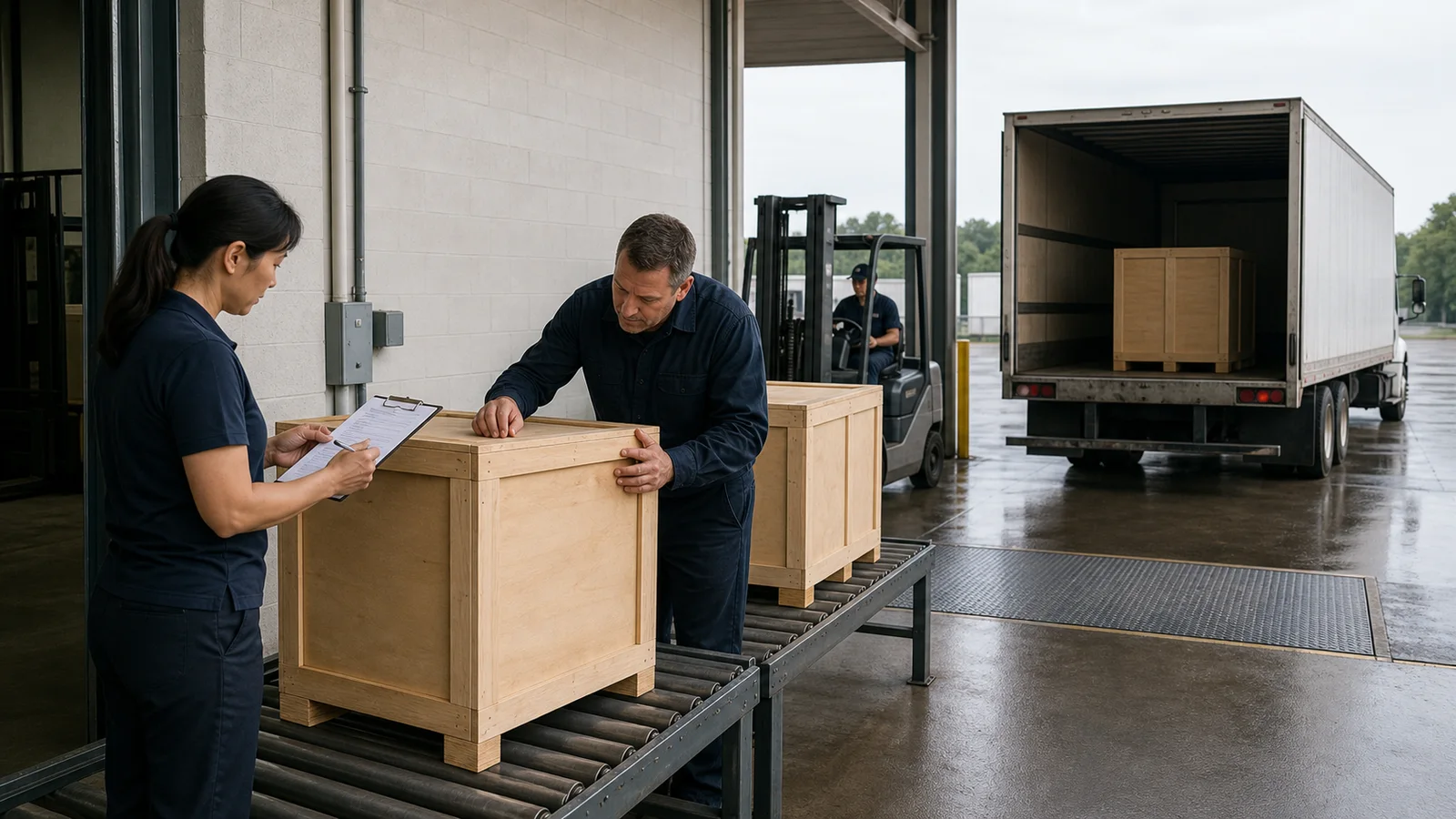
Door delivery is incomplete language until the physical endpoint is described. A quote should distinguish terminal-to-address transport from curbside placement, dock delivery, liftgate service, inside delivery, floor placement, installation, and removal of packing. The driver may not be authorized or equipped to perform every task a buyer imagines. Give the forwarder the exact address, property type, access limits, receiving hours, appointment rules, dock height, forklift capacity, largest package, and heaviest piece before the last-mile service is selected and priced correctly.
The endpoint also needs a failed-handoff rule. State who receives the delivery notice, how quickly the consignee must respond, what proof of delivery is captured, and when waiting, storage, return, or redelivery becomes chargeable. For a hypothetical example, a crated machine delivered to a street address without a forklift may require a different vehicle and crew than palletized cartons delivered to a staffed warehouse. The example is not a rate promise; it shows why the same postcode can produce a different operating scope.
- Curb, dock, room, or other exact service endpoint
- Consignee equipment and labor available at delivery
- Appointment, waiting, failed-delivery, and proof-of-delivery process
Write exclusions and exception costs before booking
A credible quote explains what is not covered. Common categories to clarify include inspections, examinations, demurrage, terminal storage, broker disbursements, permits, laboratory testing, classification work, tariff changes, address correction, remote-area service, liftgate, waiting, redelivery, disposal, and return transport. This is not a universal fee list; the actual terms depend on the lane and provider. The objective is to distinguish an ordinary included service from an event that requires new authority, third-party work, or time outside the original assumptions for that booking.
Finish with an exception matrix that names the decision maker and evidence required for extra spending. Customs controls its own examination or information requests, so no forwarder should guarantee release. The buyer should know who receives notices, who approves additional work, how supporting records are supplied, and whether the cargo can be held while a dispute is reviewed. Ask for a revised written scope whenever the commodity, value, packing, importer, address, or ready date changes, and verify all current customs and carrier rules immediately before dispatch.
- Trigger that converts an included service into an exception
- Party allowed to approve third-party costs
- Evidence and response deadline needed to keep cargo moving
Inputs to send before requesting a quote
A useful quote begins with final cargo facts and named handoffs. Send the following information together so the response can separate assumptions from confirmed scope instead of hiding gaps inside one total price.
- Exact commodity, material, intended use, model, and special contents
- Final package count, dimensions, gross weight, and stackability
- Commercial invoice value, currency, origin, and sale terms
- Proposed classification by product line and supporting product data
- Importer or declarant identity, broker authority, and destination tax numbers
- Pickup address, supplier contact, cargo-ready date, and export-document owner
- Exact delivery address, property type, access limits, and receiving hours
- Dock, forklift, liftgate, crane, crew, or inside-delivery requirement
- Insurance decision, insured value basis, exclusions, and evidence expectations
- Duty and tax assumptions, quote validity, and reconciliation method
- Inspection, storage, waiting, redelivery, and remote-area exception terms
- Named contacts authorized to answer customs questions and approve extra costs
Failure modes to control before dispatch
| Trigger | Consequence | Control |
|---|---|---|
| Duty and tax appear only inside one all-in amount | The buyer cannot test the landed-cost assumptions or assign a later adjustment | Request the classification, value, origin, rate-date, and reconciliation assumptions in writing |
| No importer or broker authority is confirmed | Cargo reaches destination before anyone can validly provide entry instructions | Confirm the importer arrangement, authorization path, tax identifiers, and broker contact before pickup |
| Door delivery is quoted from a postcode alone | The selected vehicle or service cannot complete the final handoff without extra work | Submit the address type, access, appointment, unloading equipment, and exact endpoint |
| Product restrictions are reviewed after cargo collection | The route, documents, or importer arrangement must change while cargo is already moving | Complete product, carrier-acceptance, and destination-rule checks before release |
| Examinations and storage are neither included nor excluded | An official hold creates an unassigned bill and delayed response | Use an exception matrix naming cost responsibility, approval authority, evidence, and response contacts |
Official sources and current-rule checks
The sources below support the regulatory or carrier-facing distinctions in this guide. Requirements can change by date, product, route and importer, so recheck the current primary source and the accepting carrier before dispatch.
- International Chamber of Commerce – Incoterms rules: Incoterms allocate delivery tasks, costs and risks; they do not replace a written freight scope.
- U.S. Customs and Border Protection – Importing into the United States: Commercial invoice, packing, marking and product-specific import preparation for U.S. entries.
- GOV.UK – Import goods into the UK step by step: EORI, commodity code, value, declarations, duty, VAT and record preparation for Great Britain.
- European Commission – Access2Markets: EU tariffs, procedures, formalities and product requirements by product and origin.
Related Sendwin shipping resources
Compare the available China freight service options before deciding which transport and delivery stages belong inside the DDP scope. See China freight service options.
Use the completed responsibility ledger and final cargo data to request an itemized freight quote for the actual shipment. See request an itemized freight quote.
Review air freight from China when urgent cargo needs a clearly defined airport, customs, and final-delivery handoff. See air freight from China.
Compare FCL and LCL ocean freight when container handling, destination charges, and delivery equipment affect the landed scope. See FCL and LCL ocean freight.
Use warehousing and consolidation in China when several suppliers must be reconciled, measured, and released under one approved cargo record. See warehousing and consolidation in China.
Frequently Asked Questions
Does DDP mean the buyer can ignore customs clearance?
No. The commercial arrangement may place broad delivery and import tasks on the seller, but the shipment still needs accurate goods data, a workable importer arrangement, and any required destination evidence. The buyer should understand whose identity is used and recheck current rules before dispatch.
Should duty and tax be shown as a fixed amount?
Only when the provider can clearly support that treatment for the actual shipment and explain the contractual boundary. In many quotations, a transparent estimate with classification, origin, value, currency, and adjustment assumptions is more useful than an unexplained promise.
Is unloading automatically included in door-to-door service?
Do not assume it is. Confirm whether delivery ends at the curb, dock, or another point, and state whether a liftgate, forklift, crane, labor, inside placement, appointment, or waiting time is required.
Can a forwarder guarantee that customs will not inspect the cargo?
No. Customs authorities decide whether to request information, inspect, or hold goods. A useful quote instead explains the notification, document, approval, storage, and cost process if an official intervention occurs.