

For door to door shipping from china, prevent surprise charges in door-to-door shipping from China by describing the destination as an operating site, not merely an address. Before quoting, answer who clears and pays import charges, what vehicle can enter, who unloads, whether an appointment or liftgate is needed, what insurance was selected, and when waiting, storage, or redelivery becomes chargeable. Reconfirm these answers when cargo dimensions or the delivery site changes.
Decision framework for door to door shipping from china
Use the table as a pre-booking filter. It does not choose a carrier or customs treatment by itself; each row identifies the physical facts, responsible party and written evidence that must agree for this shipment.
| Situation | Best fit | Avoid when | Verify before booking |
|---|---|---|---|
| Staffed commercial warehouse with dock and forklift | Scheduled business delivery using a vehicle compatible with the dock and package weights | Receiving hours, booking reference, dock height, or unloading capacity are unknown | Site contact, appointment process, dock access, forklift rating, and proof-of-delivery method |
| Small business or residence without a loading dock | Curbside delivery with any required liftgate and handling limits stated in advance | The consignee expects inside placement or driver labor that the service does not include | Property type, parking access, stairs, largest piece, liftgate need, and consignee labor |
| Construction site or temporary project address | Appointment delivery with a named site receiver and a confirmed unloading window | Road access, crane or forklift timing, weather exposure, or secure storage is unresolved | Vehicle route, site hours, equipment, safety access, contact availability, and failed-delivery plan |
| Remote postcode, island, restricted urban zone, or limited-access road | Coverage-confirmed delivery with accessorial and transfer legs disclosed separately | A general zone price is accepted without checking the exact street and vehicle limits | Exact-address coverage, transfer depot, remote surcharge, vehicle restriction, and delivery frequency |
| Appointment-controlled retailer, factory, or fulfillment warehouse | Pre-booked delivery using final carton or pallet data and the receiver’s current reference | The booking is made before final packing or the receiver has not issued instructions | Reference number, data cutoff, pallet count, label status, arrival tolerance, and rejection process |
Describe the destination as an operating profile
The first useful pre-quote question is not What is the postcode? It is What must physically happen when the vehicle arrives? Record whether the location is a warehouse, office, shop, residence, construction site, port area, or temporary project. Add road width, gate or height limits, parking restrictions, dock availability, delivery floor, stairs, receiving hours, and appointment rules. A carrier can serve an address yet still be unable to complete the handoff in the way the buyer expects, which is where many accessorial charges begin.
Pair the site profile with the final package profile. State the largest piece, heaviest piece, pallet count, stackability, center-of-gravity concern, and whether packaging can be moved by pallet jack. Dimensions can also change chargeable weight under parcel or freight methods, so early estimates should be labeled and replaced after repacking. For a hypothetical example, six hand-carry cartons and one dense crated unit sent to the same street require different equipment. The example illustrates an operating distinction; it is not a quote, service promise, or transit-time claim.
- Property type and exact receiving point
- Vehicle, gate, dock, parking, floor, and stair constraints
- Largest and heaviest handling unit after final packing
Ask who unloads and what the driver may do
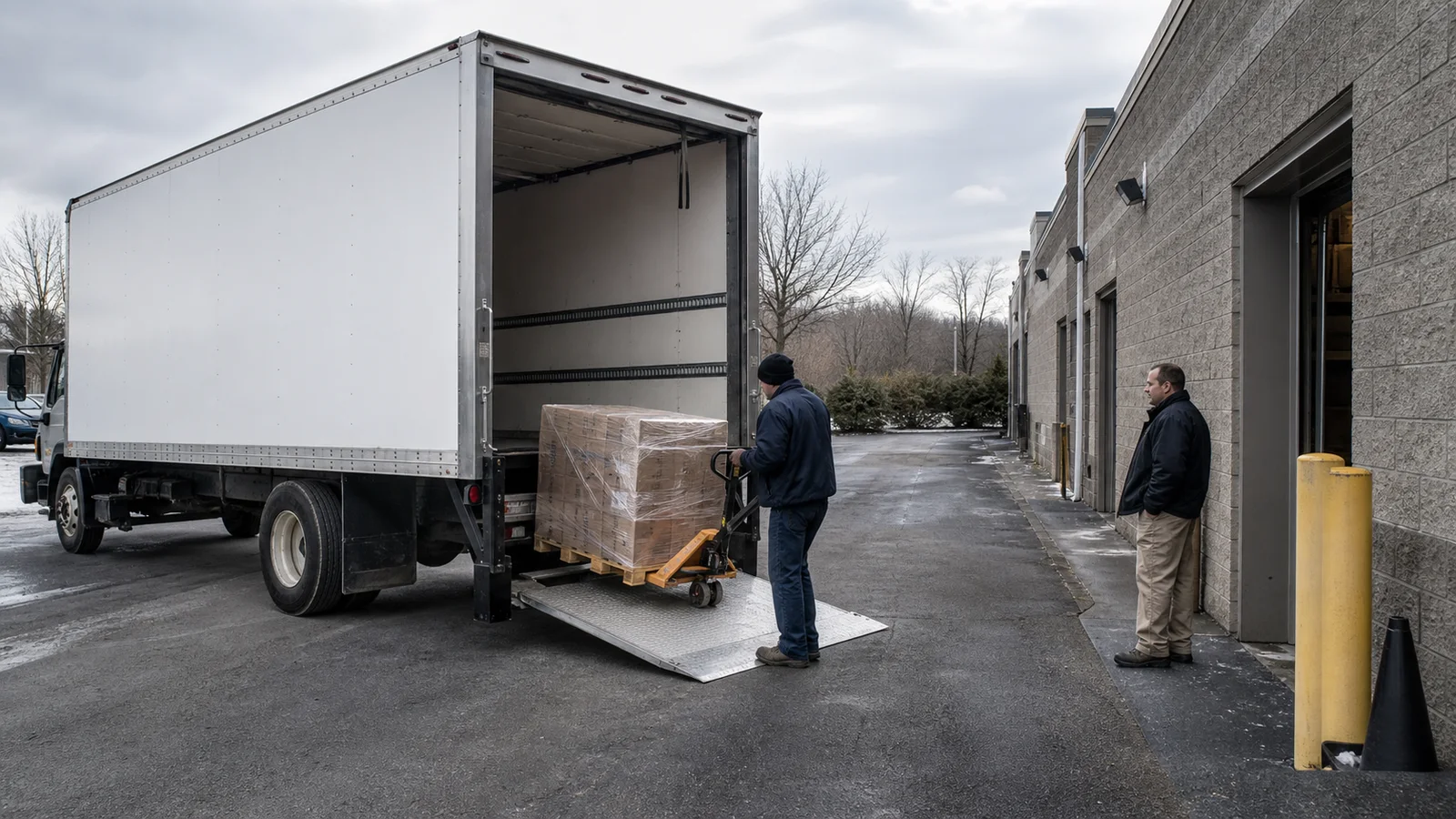
Unloading is a separate task from arriving at the address. Ask whether the service ends at the curb, vehicle tail, loading dock, or an agreed indoor point. Then identify the equipment and labor available on site. A liftgate can lower a pallet to ground level, but it does not automatically provide a forklift, long-distance carry, stair movement, unpacking, installation, or waste removal. The written scope should use physical verbs and endpoints instead of the vague phrase full delivery, which different parties can interpret differently.
Confirm who checks package count and visible condition before signing. The receiving contact should know whether to note shortages or damage, take photographs, and preserve packing for a possible claim. If the consignee cannot unload within the allowed period, define waiting, attempted delivery, return-to-depot, and redelivery handling in advance. Heavy or oversized pieces need an equipment plan based on actual weights and lifting points. Never assume a driver can improvise safely when a crane, forklift, crew, or site permit was omitted from the request.
- Exact point where carrier responsibility for placement ends
- Liftgate, forklift, crane, pallet jack, or manual crew owner
- Condition-check and proof-of-delivery procedure
Separate import charges from delivery charges
Door to door describes geography, not automatically the customs payment model. Ask whether duty, import tax, broker work, disbursement, permits, and official examination costs are included, estimated, advanced, or billed to another party. Identify the importer or declarant arrangement and the person authorized to answer product, value, and origin questions. A quote can include final trucking while leaving government charges to the consignee, or it can use a DDP structure with conditions. Those are different commercial offers even if both end at the same door.
Request the assumptions behind any duty or tax estimate: product description, proposed classification, origin, value, currency, and rule date. Do not alter the commercial record to fit an earlier total. Destination systems and requirements can change, and some products need registrations or evidence beyond routine freight paperwork. Before dispatch, the importer or qualified adviser should verify current official rules for the actual destination and goods. The quote should explain who handles an adjustment, request for information, inspection, or product restriction rather than implying the forwarder controls customs decisions.
- Importer, broker, and authorization arrangement
- Duty, tax, disbursement, and official-charge treatment
- Current-rule verification owner before cargo release
Choose insurance by exposure and evidence
Do not let insurance remain a yes-or-no checkbox. Ask what value basis is covered, which events and legs are included, what packaging obligations apply, what exclusions matter for the commodity, and what evidence is needed after loss or damage. Carrier liability and cargo insurance are not automatically the same as the invoice or replacement value. High-value, fragile, theft-sensitive, temperature-sensitive, or difficult-to-replace goods deserve an explicit review before pickup, including whether partial loss, concealed damage, and destination handling fall within the selected protection.
Build the evidence process before the claim exists. Photograph internal protection, closed cartons, pallet condition, seals where used, package count, and handoff condition. Decide who inspects at delivery, how quickly an issue must be reported under the chosen terms, and where damaged goods will be held. For multi-supplier consolidation, preserve supplier and carton references after repacking. Insurance cannot correct poor packaging or missing records; it works best when the cargo identity, declared value, packing method, and chain of custody remain consistent from China to destination.
- Insured value basis and excluded events
- Packing, photo, and condition evidence required
- Notice, survey, preservation, and claim-contact process
Define storage, waiting, and failed-delivery triggers
Extra costs usually have a clock or event behind them. Ask when free or included handling ends, what starts terminal or warehouse storage, how long a vehicle may wait, what counts as an attempted delivery, and whether an address correction or appointment change creates a new charge. The answer should identify both the trigger and the notification method. Without that pair, the buyer may learn about accumulating cost only after cargo has already missed a customs response, pickup window, or receiving appointment.
Create an escalation chain with a primary and backup contact in both time zones. Give the forwarder written authority limits: which routine actions may proceed, which costs require approval, and what happens if the buyer cannot be reached. Confirm whether storage can arise at an origin warehouse, airport or port terminal, customs-controlled facility, destination depot, or failed-delivery location. These are separate custody points. Recheck the current booking, carrier, customs, and delivery terms immediately before dispatch because route availability and operational rules can change.
- Event and timestamp that begins each charge
- Notice channel and decision deadline
- Primary, backup, and after-hours approval contacts
Inputs to send before requesting a quote
A useful quote begins with final cargo facts and named handoffs. Send the following information together so the response can separate assumptions from confirmed scope instead of hiding gaps inside one total price.
- Exact delivery address and whether it is commercial, residential, temporary, or restricted access
- Receiving hours, appointment method, reference requirements, and named site contact
- Road, gate, height, parking, dock, floor, stair, and vehicle restrictions
- Final package and pallet count, dimensions, gross weight, and stackability
- Largest piece, heaviest piece, lifting points, and center-of-gravity concerns
- Available dock, forklift, liftgate, crane, pallet jack, and receiving labor
- Commodity, intended use, value, origin, special contents, and proposed classification
- Importer, customs broker, tax-number, and duty or tax payment arrangement
- Insurance value basis, packing evidence, exclusions, and claim contacts
- Waiting allowance, storage triggers, address-correction, and redelivery terms
- Remote-area or transfer-depot coverage for the exact street
- Primary and backup contacts authorized to approve exceptions
Failure modes to control before dispatch
| Trigger | Consequence | Control |
|---|---|---|
| A residential or limited-access address is quoted as a standard business dock | The vehicle cannot unload or complete the promised handoff | Declare the property type, access limits, endpoint, liftgate need, and available labor before quoting |
| Carton or crate dimensions change after the booking | Chargeable weight, vehicle choice, or appointment data no longer matches the cargo | Remeasure after final packing and obtain written acceptance of the revised cargo record |
| Duty and tax responsibility is inferred from the words door to door | Customs payment or importer action remains unassigned at arrival | State the Incoterm, importer arrangement, government-charge treatment, and adjustment process separately |
| The receiver misses an appointment or cannot unload | Waiting, attempted-delivery, storage, or redelivery activity begins | Confirm the contact, booking reference, equipment, time window, and failed-delivery terms before dispatch |
| Damage is discovered after packing and delivery evidence has been discarded | The buyer cannot demonstrate condition, custody, or compliance with claim requirements | Agree the photo, inspection, notation, preservation, notice, and claim process before pickup |
Official sources and current-rule checks
The sources below support the regulatory or carrier-facing distinctions in this guide. Requirements can change by date, product, route and importer, so recheck the current primary source and the accepting carrier before dispatch.
- International Chamber of Commerce – Incoterms rules: Incoterms allocate delivery tasks, costs and risks; they do not replace a written freight scope.
- FedEx – Dimensional weight: Parcel billing can use dimensional or actual weight, whichever is greater.
- UPS Supply Chain Solutions – Chargeable and volumetric weight: Mode-specific chargeable-weight concepts for air, express and LCL freight.
- GOV.UK – Import goods into the UK step by step: EORI, commodity code, value, declarations, duty, VAT and record preparation for Great Britain.
Related Sendwin shipping resources
Use the door-to-door freight service hub to compare which origin, transport, customs, and delivery tasks need a written scope. See door-to-door freight service hub.
After confirming site access and unloading, submit a destination-ready quote request with the final cargo and customs details. See submit a destination-ready quote request.
Review air freight door-delivery planning when an airport handoff, customs release, and urgent final mile must work as one chain. See air freight door-delivery planning.
Compare ocean freight delivery options when container, LCL depot, unloading, and destination access can change the final charge. See ocean freight delivery options.
Use China warehousing and consolidation to confirm final package dimensions and supplier records before a door-delivery booking is locked. See China warehousing and consolidation.
Frequently Asked Questions
Does door-to-door shipping always include duty and tax?
No. Door to door can describe the physical route while the customs and payment arrangement varies. Ask for the Incoterm, importer identity, broker role, duty and tax treatment, and adjustment terms as separate written items.
What is the most important address detail after the postcode?
The operating conditions at the exact receiving point matter most: property type, access, dock, floor, stairs, hours, appointment, unloading equipment, and heaviest piece. Those details determine whether the planned vehicle and handoff can actually work.
Will a liftgate place cargo inside the building?
Not automatically. A liftgate generally addresses movement between vehicle and ground, while inside placement, long carry, stairs, unpacking, installation, or extra labor may be separate or unavailable. Confirm the exact endpoint in writing.
When should storage terms be checked?
Check them before booking, not after a hold occurs. Identify each possible custody point, the event that starts charging, the notice method, the approval contact, and the action needed to stop the clock.