

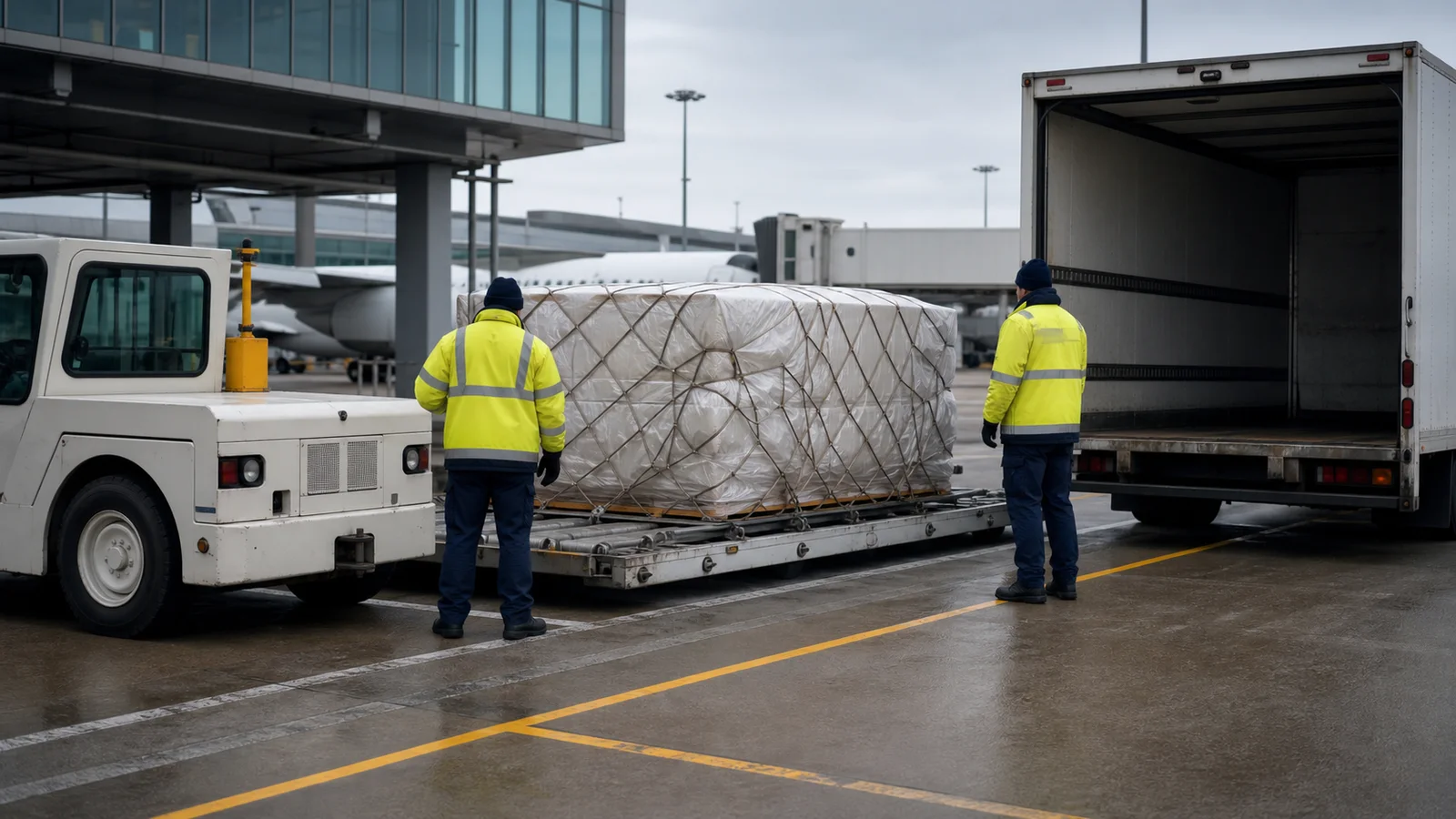
Use airport pickup for air freight from China to Canada when the importer has its commercial-import account ready, an appointed broker, a confirmed arrival airport, and a collector that can obtain release and move the cargo safely. Choose door delivery when the consignee lacks that local operating chain or the final address creates a complex cartage leg. Compare the complete destination scope, not airport freight against a delivered total.
Decision framework for air freight from china to canada
Use the table as a pre-booking filter. It does not choose a carrier or customs treatment by itself; each row identifies the physical facts, responsible party and written evidence that must agree for this shipment.
| Situation | Best fit | Avoid when | Verify before booking |
|---|---|---|---|
| Importer has an active Canadian commercial-import setup, broker, and regular airport collector | Request airport-to-airport pricing with a written destination handoff | The arrival airport or release process differs from the importer’s normal lane | Importer account, broker authority, airport, handling contact, collector, and release evidence |
| Consignee is inland and does not control local freight collection | Request door delivery with the cartage leg priced and assigned | The quote says delivery included without naming endpoint or site conditions | Postal code, address type, delivery radius, vehicle, appointment, access, and unloading |
| A local trucker is available but customs brokerage is not confirmed | Establish the importer and broker workflow before selecting airport pickup | Collection is planned around flight arrival rather than customs and handling release | Broker instructions, commercial documents, release sequence, and exception contacts |
| Cargo is bulky, palletized, or contains a single heavy piece | Match the airport and final-mile equipment to the finished cargo profile | A parcel van or manual unloading is assumed from carton count alone | Piece dimensions, gross weight, chargeable weight, forklift needs, and vehicle capacity |
| Commodity contains batteries or another acceptance-sensitive feature | Confirm current route acceptance before fixing either delivery model | The supplier relies on a prior approval or vague safety description | Exact configuration, packing, available evidence, airline route, and current rules |
Choose airport pickup only when the receiver owns the handoff
Airport pickup transfers destination work to the importer and consignee. They need an appointed broker, a monitored arrival-notice contact, a clear method for paying or approving destination charges, release evidence, and a collector with the correct vehicle. Proximity to an airport is not enough. Ask whether the receiver has handled commercial cargo at that specific gateway and who acts when the regular contact is unavailable. If the answer is a chain of assumptions, door delivery may offer a clearer responsibility path even though it includes a larger destination scope.
Door delivery does not remove importer duties or product-compliance responsibility. It adds coordination for the local leg from the airport or handling facility to a defined address. The quote should still state who acts as importer, who instructs the broker, who pays duty and tax, and where delivery ends. A hypothetical buyer with a broker and loading dock near Toronto may prefer airport pickup; a consignee at a restricted inland site may need coordinated delivery. Neither model is universally cheaper because the buyer’s own capability changes the comparison.
- Named arrival-notice recipient and backup
- Broker, release, collector, and vehicle ownership
- Defined final endpoint for any door-delivery offer
Confirm Canadian importer and commercial-account readiness
Before origin pickup, the Canadian importer should confirm its current commercial-import accounting setup, business identifiers, delegation or broker authority, and the party responsible for declarations and payment. CARM processes and government requirements can change, so the importer should review current CBSA guidance and obtain qualified assistance where needed. A freight forwarder can coordinate the shipment and transmit supplied information, but a transport quote is not evidence that the importer account is ready or that the goods meet every destination requirement.
Give the broker a draft invoice and packing record early enough to correct it. The commercial invoice should identify the parties, describe the goods specifically, and present quantities, values, currency, origin, and other required transaction details consistently. Package totals should match the finished cargo. The importer should confirm classification and product-specific requirements rather than asking the forwarder to invent a code or provide legal advice. Recheck the final records and current rules before dispatch, especially when the product, value structure, importer, or delivery province has changed since a prior shipment.
- Current importer account and broker authority
- Broker-reviewed commercial invoice and packing record
- Classification and product requirements confirmed by the responsible party
Map the airport release sequence before booking
Aircraft arrival does not make freight immediately collectible. Cargo information must reach the destination parties, the handling facility must process and make the shipment available, the broker must obtain the applicable customs release, and other release conditions must be satisfied before collection. Ask the forwarder to identify the destination contact and notification route, then ask the consignee to document its internal response. Planning a truck from the flight schedule alone risks sending it before release or after a useful collection window has passed.
The collector should know the shipment reference, piece count, dimensions, gross weight, pallet or crate condition, and evidence required at the facility. Confirm whether loading assistance is available and whether the vehicle can handle the tallest, longest, or heaviest unit. If the cargo changes during consolidation or repacking, update both the air booking and pickup plan. Airport-to-airport service works best when the handoff is rehearsed on paper: notice received, broker alerted, release confirmed, collector authorized, equipment matched, and onward address ready.
- Notification, availability, customs, and handling-release milestones
- Collector authority and release evidence
- Finished cargo profile supplied to the pickup company
Price the delivery radius and receiving site as real freight legs
Local cartage is not a generic add-on. Distance from the gateway, postal code, commercial or residential address type, road and vehicle restrictions, appointment rules, dock or liftgate needs, forklift availability, and unloading responsibility can change the delivery plan. Provide those facts before asking for a door price. If the consignee will collect, include its truck, labor, waiting exposure, and coordination effort in the comparison. A distant final address may also make a different Canadian gateway worth evaluating, but only through a complete route and broker review.
Define completion in physical terms. Does delivery end at the curb, loading dock, warehouse receiving bay, or another agreed point? Who removes a pallet or heavy crate from the vehicle, and what happens if the receiver is closed or rejects damaged outer packaging? The forwarder should not promise site services that have not been scoped. Ask for the local carrier’s required receiving window and exception contact. If the site cannot receive the piece safely, resolve equipment or alternate-address options before dispatch rather than improvising after customs release.
- Exact postal code and address type
- Access, appointment, vehicle, and equipment requirements
- Named unloading owner and failed-delivery process
Compare airport and door offers on one responsibility sheet
Normalize both options into origin pickup, export handling, air transport, destination handling, brokerage, duty and tax responsibility, release-related charges, local cartage, appointment, special equipment, insurance, and exception work. Record the arrival airport, priced chargeable weight, route, cargo-ready date, service endpoint, and validity period. An airport offer may correctly exclude several destination items; a door offer may still exclude duties, unusual access, storage, or unloading. The decision becomes useful only when every exclusion has a named owner and neither total hides a different cargo snapshot.
The release gate is a written approval of the final packages, accepted commodity, documents, importer account and broker setup, route, destination model, and contacts. If the supplier changes dimensions, weight, battery configuration, value, or ready date, obtain a revised approval. Recheck current CBSA, carrier, and product rules before dispatch where they can change. Do not convert an estimated price into permission to ship. When the buyer cannot prove that airport pickup roles are ready, choose a defined door scope or pause until the destination chain is complete.
- Same cargo and route assumptions across both offers
- All destination exclusions assigned to a party
- Current-rule check attached to final release
Inputs to send before requesting a quote
A useful quote begins with final cargo facts and named handoffs. Send the following information together so the response can separate assumptions from confirmed scope instead of hiding gaps inside one total price.
- Supplier pickup address, factory contact, and cargo-ready date
- Exact commodity, material or function, model, quantity, and origin
- Final piece count, dimensions, gross weight, and stackability
- Pallet, crate, longest-side, heavy-piece, and forklift details
- Battery, liquid, powder, magnet, or other acceptance-sensitive contents
- Available current test, safety, and carrier-requested documents
- Commercial value, currency, transaction details, and insurance request
- Canadian importer account status and customs broker contact
- Preferred arrival airport and acceptable alternatives
- Airport collector, vehicle, release process, and onward address
- Final postal code, address type, receiving hours, access, and unloading needs
- Requested airport or door scope, responsibility exclusions, and quote validity
Failure modes to control before dispatch
| Trigger | Consequence | Control |
|---|---|---|
| Airport pickup is selected because the consignee is geographically close | No broker, release owner, or authorized collector is ready when cargo arrives | Approve the complete notice-to-collection workflow before booking airport service |
| Canadian importer-account setup is assumed from a previous shipment | Current accounting, delegation, or payment work is incomplete at arrival | Recheck current CARM and importer arrangements with CBSA guidance and the broker before dispatch |
| Local delivery is quoted from a city name rather than an exact site | Vehicle, access, appointment, or unloading requirements appear after release | Provide postal code, address type, restrictions, equipment, and endpoint before pricing |
| Collector receives factory estimates instead of final package data | The vehicle or handling equipment cannot safely move the freight | Send final piece dimensions, gross weight, and handling restrictions after packing |
| Door delivery is treated as including every destination cost and task | Duty, tax, brokerage, storage, or unloading responsibility remains disputed | Mark every destination line included, excluded, or buyer-controlled in the written scope |
Official sources and current-rule checks
The sources below support the regulatory or carrier-facing distinctions in this guide. Requirements can change by date, product, route and importer, so recheck the current primary source and the accepting carrier before dispatch.
- Canada Border Services Agency – CARM: Current Canadian commercial-import accounting, business number and importer-account workflow.
- Canada Border Services Agency – Invoice requirements: Commercial invoice requirements for goods imported into Canada.
- UPS Supply Chain Solutions – Chargeable and volumetric weight: Mode-specific chargeable-weight concepts for air, express and LCL freight.
- International Air Transport Association – Batteries: Current battery classification, packing, documentation and air-transport guidance.
Related Sendwin shipping resources
Review the China-to-Canada air freight service when comparing an airport endpoint with coordinated door delivery. See China-to-Canada air freight service.
Request a Canada air-freight comparison after importer, airport, cargo, and final-address facts are complete. See request a Canada air-freight comparison.
Use warehouse consolidation in China when suppliers need receiving checks, repacking, or a single final cargo record. See warehouse consolidation in China.
Compare international express delivery for smaller accepted consignments that do not justify an airport pickup chain. See international express delivery.
Review ocean freight alternatives to Canada when only a limited portion of the order needs air service. See ocean freight alternatives to Canada.
Frequently Asked Questions
Does airport pickup remove the need for a Canadian customs broker?
No. Airport collection and customs release are separate tasks. The importer should confirm the declaration process, broker authority, and current account requirements before the shipment leaves China.
What should a door-delivery quote include in Canada?
It should define the gateway, brokerage scope, local cartage, final postal code, address type, appointment, access, equipment, and unloading endpoint. Duty, tax, storage, and exceptional services should be shown as included, excluded, or payable by another party.
Can I choose the nearest Canadian airport?
Not by distance alone. Confirm route availability, commodity acceptance, broker capability, handling process, collection equipment, and the complete onward-delivery leg before choosing the gateway.
When is airport pickup the better cost-control model?
It can work when the importer already controls brokerage and local collection and can respond quickly to release events. Include the buyer’s truck, labor, coordination, and exception exposure when comparing it with door delivery.