

CNC Machine Shipping From China: Packaging, Documents, Mode, and Risk Checklist
Primary-source baseline captured on 16 July 2026. Carrier acceptance, customs treatment, rates and schedules can change by shipment; recheck the linked authority and the accepting provider before cargo release.
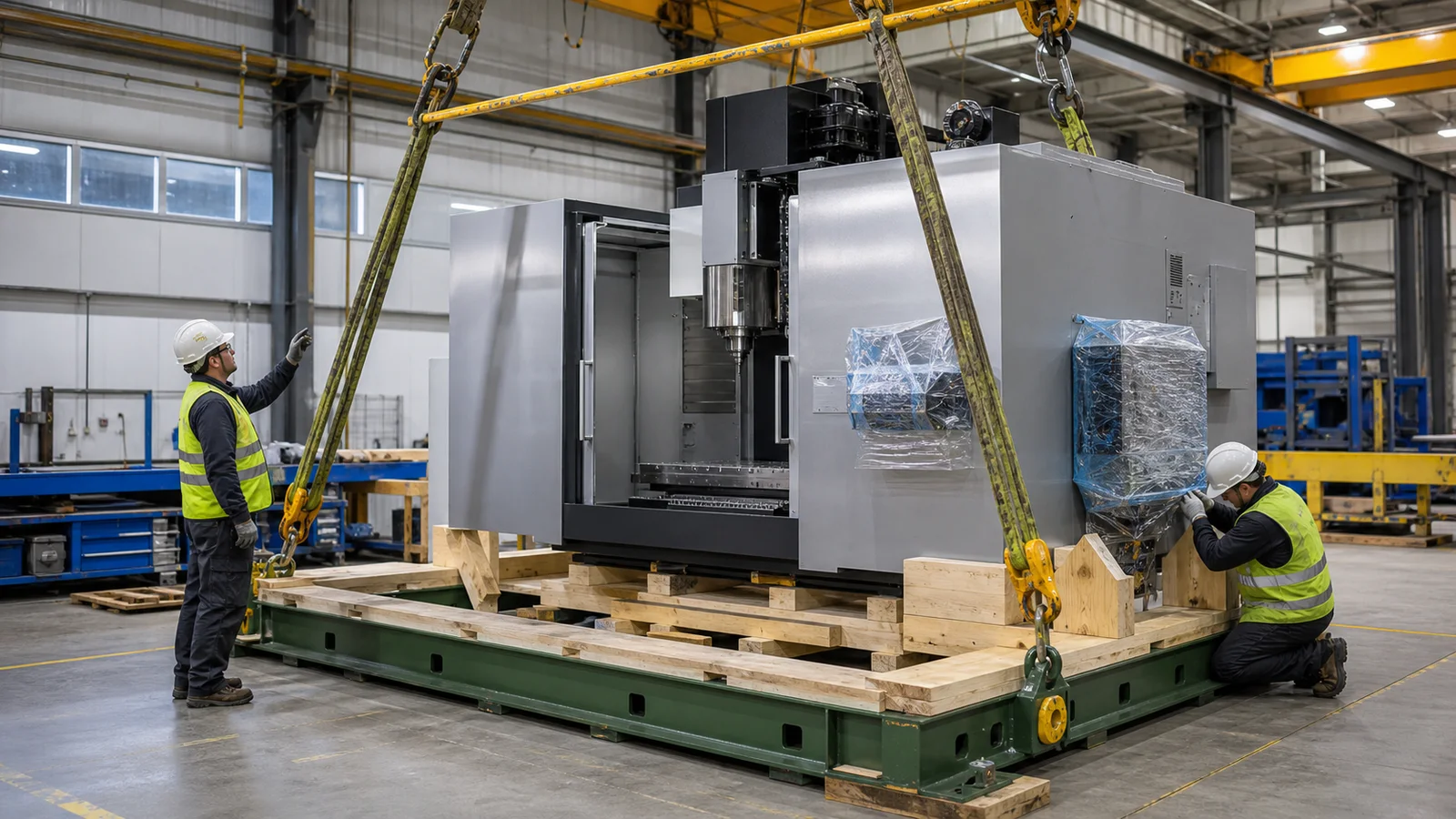
CNC machine shipping from China should begin with the exact machine model, operating condition, dimensions, mass, center of gravity, lifting points, fluids, batteries, loose assemblies and destination installation path. The supplier and buyer should approve a shutdown and preservation method, engineered base or crate, lifting plan, selected transport equipment, customs file and receiving protocol before booking. A machine that geometrically fits inside a container may still exceed door, floor, point-load, payload, lashing, lifting or destination-access limits. Measure and weigh the final packed unit, preserve condition evidence and obtain written acceptance from the packer, rigging provider, forwarder and receiving team for their respective work.
CNC machine transport-readiness matrix
Select equipment and packing only after the machine condition and handling data are verified. Each release gate needs evidence from the owner who controls that risk.
Information-gain asset: Turn CNC machine shipping from China into a shipment-readiness matrix covering acceptance-sensitive contents, packing evidence, documents, mode rejection rules, and exception ownership.
| Machine condition | Primary exposure | Control owner | Stop-release evidence |
|---|---|---|---|
| Complete enclosed machine | Mass, center of gravity, fluids and sensitive axes | Manufacturer and buyer engineer | Approved machine data sheet and shutdown record |
| Partly dismantled machine | Lost alignment, mixed parts and reassembly errors | Manufacturer and installation team | Dismantling map, tags, photographs and parts register |
| Container-compatible packed unit | Door, floor, payload, lashing and unloading limits | Packer and forwarder | Final survey, equipment confirmation and load plan |
| Out-of-gauge or heavy unit | Lift capacity, abnormal road and special equipment | Qualified rigging and route providers | Engineered lift, route and carrier acceptance |
| Machine with controlled contents | Dangerous goods, export control or product compliance | Shipper, importer and compliance owners | Classification, authorization and acceptance evidence |
Survey the machine as a transport object
The sales model number does not describe the load. Create a transport data sheet from the actual machine and distinguish the operating assembly from every loose, removed or separately packed component.
Record manufacturer, model, serial number, machine and control-cabinet dimensions, operating mass, transport mass, center-of-gravity location, approved lifting points, base contact area and point loads. Identify projecting guards, tool changers, conveyors, chip systems, cooling units, transformers, probes and accessories. State whether each item stays attached, is immobilized or ships separately. Use manufacturer drawings and a physical survey; do not derive lifting data from brochure dimensions.
Trace the path from factory floor to transport equipment and from destination vehicle to final foundation. Measure doorways, turning radius, overhead clearance, floor capacity, crane or forklift approach, dock level and staging area. A container fit result is irrelevant when the machine cannot reach the container door or the receiving site cannot unload it. Name the engineer or qualified provider that accepts each lifting and access decision.
- Model, serial number and machine revision.
- Transport dimensions, mass and center of gravity.
- Certified lifting points and base load distribution.
- Removed components and package identifiers.
- Origin and destination movement-path survey.
Control shutdown, fluids and preservation
Condition can deteriorate before the first lift. The manufacturer should issue a shutdown and transport-preservation procedure that protects precision surfaces, electronics, lubrication systems and moving assemblies for the planned duration and climate.
Complete the machine’s approved shutdown, backup parameters and record software or control versions. Secure axes, spindle, turret, tool changer, doors and movable guards with manufacturer-approved restraints. Drain, reduce or retain coolant, hydraulic oil, lubricants, refrigerants and other fluids only under the machine procedure and transport rules. Identify residual liquids in the dangerous-goods and carrier review instead of assuming drained means empty.
Clean and dry exposed areas, protect machined surfaces against corrosion, cap openings and preserve electrical cabinets against moisture and contamination. Select barrier material, desiccant, indicators or controlled ventilation based on the route and machine requirements. Record application date, quantity or condition indicators and the destination removal procedure. Unapproved wrapping can trap moisture or damage painted and precision surfaces, so the preservation design needs manufacturer acceptance.
| System | Release action | Evidence | Receiving action |
|---|---|---|---|
| Controls and software | Backup and controlled shutdown | Version and backup record | Verify before energizing |
| Axes and spindle | Park and restrain as approved | Position photographs and tag list | Remove restraints under procedure |
| Fluids | Document retained, drained and residual contents | Fluid register and disposal plan | Refill and leak inspection |
| Precision surfaces | Clean and apply approved protection | Preservation log | Inspect and remove protection |
| Electrical cabinets | Moisture and shock protection | Seal and indicator record | Condition before power-up |
Engineer the base, crate, lift and securing plan
A heavy export crate is a structural and handling system. It must transfer machine loads into the transport unit, expose safe handling points and resist the expected movement without relying on the crate walls alone.
Design the skid or base for the measured mass, center of gravity, point loads, lift method and securing arrangement. Use suitable fasteners and blocking at manufacturer-approved locations. Identify forklift pockets, sling paths, lifting beams or jack points and mark them consistently on drawings and the package. OSHA’s cited rigging standard requires equipment within its scope to carry legible working-load identification, remain within rated capacity and be inspected; local workplace rules and a qualified rigging provider control the actual lift.
Protect against longitudinal, transverse and vertical transport forces using an engineered blocking, bracing and lashing plan. The CTU Code emphasizes load distribution and securing throughout intermodal transport. Check container floor capacity, concentrated loads, lashing-point ratings and wall limitations with the equipment provider. Use compliant treated wood packaging where ISPM 15 applies and preserve mark evidence. Photograph the bare machine, preservation, base connections, internal blocking, closure, marks and final dimensions.
- Base and crate calculation or approved design.
- Rated rigging gear and qualified lift method.
- Blocking, bracing and lashing drawing.
- Wood-packaging compliance where applicable.
- Stage-by-stage photographs and package marks.
Select transport equipment by all limiting dimensions
Compare a standard container, open top, flat rack, breakbulk or other special service against the complete packed unit and every handling event. Nominal equipment names are not acceptance evidence.
For a standard container, test door width and height, internal envelope, payload, floor loading, center of gravity, lashing access and the ability to move the load through the door without striking the frame or roof. For open-top or flat-rack equipment, confirm over-dimension data, lifting method, carrier survey, securing, weather protection and terminal restrictions. Obtain the assigned or accepted equipment specification because fleets vary by manufacturer and series.
Build the route around loading and unloading capability. State crane or forklift capacity at required load center, spreader or beam needs, rigging clearances, container positioning, site access, road or bridge restrictions and permits. Compare FCL, special equipment and breakbulk on total handling exposure and destination readiness, not only ocean freight. A transshipment can introduce another lift that the packing and securing plan must withstand.
| Equipment path | Useful condition | Acceptance question | Destination prerequisite |
|---|---|---|---|
| Standard dry container | Packed unit fits door and all load limits | Can it be inserted, secured and removed safely? | Door-level unloading equipment and space |
| Open top | Top loading resolves height or handling | Are lift, over-height and weather controls accepted? | Crane and top-access plan |
| Flat rack | Out-of-gauge cargo needs side or top access | Are dimensions, point loads and securing approved? | Heavy-lift and route permits |
| Breakbulk | Unit or route exceeds container solution | Are terminal lifts and vessel stowage confirmed? | Port and inland heavy-haul plan |
Reconcile documents, customs and receiving condition
The document file should identify the machine and every package consistently, while the receiving protocol protects evidence before unpacking or energizing.
Use specific descriptions, model and serial references on the commercial invoice and packing list. Identify new or used condition, machine value, separately packed accessories, origin, package marks, net and gross weights and dimensions. Support classification and customs value with technical and transaction records. Screen controls, software, lasers, batteries, pressurized components, lubricants, wooden packaging and other regulated contents. The importer owns destination product and import requirements even when the forwarder coordinates documents.
At arrival, photograph the outer package, tilt or shock indicators, seals, moisture evidence, base and visible damage before moving or opening. Compare package marks and accessory counts. Unpack under the manufacturer’s sequence with qualified lifting resources. Inspect corrosion, restraints, alignment-sensitive parts, leaks and cabinet condition before power-up. Quarantine exceptions and preserve the crate, indicators and transport documents until the buyer, insurer and responsible providers agree on survey and mitigation.
- Commercial and technical identity reconciliation.
- Classification, value, origin and control screening.
- Final packing list and transport drawing.
- Arrival condition and indicator evidence.
- Unpacking, installation and exception authority.
Worked control example: vertical machining center by ocean
A buyer purchases a 7.8-ton vertical machining center in Jiangsu. The supplier proposes a standard container based only on the machine’s uncrated brochure dimensions and says the destination can unload with a forklift.
- The manufacturer surveys transport mass, center of gravity, lifting points, control cabinet and removable chip conveyor, then issues shutdown and preservation instructions.
- The packer designs a restrained skid and barrier package; final height exceeds the standard door, so the forwarder evaluates an accepted open-top plan with top loading instead of forcing door entry.
- A qualified rigging provider confirms crane, spreader and sling geometry at origin and destination; the carrier reviews final dimensions, weight, point loads, lashing and weather protection.
- The receiver prepares a crane pad and indoor staging area, records package and indicator condition, then unpacks and removes transport restraints under the manufacturer’s sequence.
The transport choice follows final packed geometry and handling engineering, avoiding a failed container load and an unsafe destination lift.
Failure controls before cargo release
Use this table as a stop-release check. A responsible owner should resolve each trigger against the same cargo and document version before the shipment moves to the next handoff.
| Failure trigger | Operational consequence | Required control |
|---|---|---|
| Equipment is selected from brochure dimensions | The final package may fail door, payload or loading limits | Survey and approve the completed transport package |
| Center of gravity and lifting points are unknown | Rigging can become unstable or overload equipment | Use manufacturer data and a qualified lifting plan |
| Plastic wrapping is treated as preservation | Moisture and corrosion can develop unseen | Approve route-specific cleaning, barrier and indicator controls |
| Crate walls are expected to secure the machine | The load can shift under transport forces | Engineer the base, blocking, bracing and lashing path |
| Receiving opens or energizes before inspection | Evidence and machine safety can be compromised | Follow a documented condition, unpacking and power-up protocol |
Quote-ready data handoff
Send the inputs together and label estimates. This gives the forwarder, carrier, broker and consignee one controlled starting version instead of a price request assembled from conflicting messages.
- Manufacturer, model, serial number and new or used condition
- Transport dimensions, mass and center-of-gravity coordinates
- Approved lifting points, base contact and point loads
- Removed assemblies and separately packed accessory list
- Fluid, battery, refrigerant and controlled-content status
- Shutdown, restraint and preservation specification
- Final skid or crate dimensions, gross weight and photographs
- Origin loading equipment and movement-path survey
- Destination access, lift, staging and installation plan
- Required equipment, customs file, delivery event and exception contacts
Primary sources and verification boundary
These sources support the document, customs or dangerous-goods distinctions used in this guide. They do not replace a product-specific ruling, licensed customs advice or carrier acceptance for the actual shipment.
- UNECE – IMO/ILO/UNECE CTU Code: The CTU Code provides a global non-mandatory practice for packing, load distribution, blocking, bracing and securing cargo in transport units.
- U.S. Occupational Safety and Health Administration – Rigging equipment for material handling: Rigging equipment within the standard’s scope must be inspected, carry legible working-load identification and stay within rated capacity; custom lifting accessories require marked safe working loads and proof testing.
- International Maritime Organization – Cargo securing and packing: Proper stowage, load distribution and securing are safety controls; inadequate securing, overloading and cargo misdeclaration create risks during loading, carriage and discharge.
- International Plant Protection Convention – ISPM 15: Wood packaging and dunnage phytosanitary requirements for international trade.
- General Administration of Customs of China – Import and Export Declaration Documents: China export declarations may require the contract, invoice, packing list, manifest, transport document and applicable licences to reconcile.
- EUR-Lex – Machinery Regulation (EU) 2023/1230: Importer conformity, documentation and marking responsibilities for machinery in the EU.
Related Sendwin resources and next actions
Use the links below to move from the reference answer into a live shipment decision. Each anchor identifies the destination topic so the relationship remains useful to buyers and search systems.
Compare CNC cargo with other controlled products in the shipping routes from China hub.
Evaluate dedicated equipment through the FCL shipping service.
Build machine and package records in the shipping documents hub.
Assign importer and tariff decisions with the customs clearance guide.
Test preliminary package geometry with the container loading calculator.
Submit the final machine survey through the freight quotation request.
Continue the route and handoff workflow with the shipping from China to Spain.
Frequently asked questions
The short answers below preserve the responsibility boundary. Confirm the actual cargo, date, lane, importer and accepting provider before relying on a general answer for release.
Can a CNC machine ship in a standard container?
Only when the final packed unit passes door, internal, payload, floor, point-load, lashing, loading and unloading checks for the accepted container. Brochure dimensions are insufficient.
Does a CNC machine need a wooden crate?
The package depends on the machine, route and handling plan. A skid, barrier system and engineered enclosure may be used, but the design must transfer loads and protect the actual equipment.
Should coolant and oil be drained before shipping?
Follow the manufacturer’s shutdown procedure and applicable transport rules. Record every retained, reduced or drained fluid and residual content; do not make an uncontrolled blanket decision.
Who should approve the CNC lifting plan?
Use manufacturer lifting data and a qualified rigging or engineering provider under the rules applicable at each site. The freight quotation alone is not lifting approval.
Ready to test the plan against final cargo data? Request a shipment-specific freight quotation.
Share the Post: