

Primary-source baseline captured on 16 July 2026. Carrier acceptance, customs treatment, rates and schedules can change by shipment; recheck the linked authority and the accepting provider before cargo release.
A freight broker, in the U.S. motor-carrier context, is a person or company that for compensation arranges transportation of property by an authorized motor carrier. FMCSA states that a broker does not transport the property, operate the vehicles or assume responsibility for the cargo being transported. A property broker needs the applicable FMCSA authority and financial security. From 16 January 2026, updated rules govern the liquidity, suspension and trustee conditions for the required $75,000 surety bond or trust. Before tendering a load, a shipper should verify current broker authority, financial-security status, carrier-selection process, contract terms, payment and claim contacts, and the identity of the actual motor carrier.
Freight broker use and verification matrix
This matrix applies to the U.S. motor-freight broker role. Other countries and transport modes use different legal definitions, so do not project this authority onto customs, ocean or international forwarding work.
Information-gain asset: Define freight broker in one quotable paragraph, then add trigger, owner, operational consequence, evidence, exception and related-decision modules that dictionary pages omit.
| Shipment need | Broker function | Shipper control | Evidence before tender |
|---|---|---|---|
| Find an authorized motor carrier | Solicit and arrange a carrier | Define load and carrier criteria | Active broker and carrier authority |
| Coordinate pickup and delivery | Communicate appointments and status | Provide truthful cargo and site data | Rate confirmation and appointment record |
| Use a subcontracted carrier | Disclose and contract the selected motor carrier | Approve prohibited re-brokering controls | Named carrier and operating identifiers |
| Resolve delay or service failure | Escalate among shipper and carrier | Make cargo and commercial decisions | Event log and written recovery approval |
| Handle loss or damage notice | Direct notice under the contracts and preserve communication | Retain evidence and follow claim terms | Carrier, broker and insurer contacts |
Use the U.S. motor-freight definition precisely
Freight broker is often used casually for many intermediaries, but the FMCSA definition addresses an arranging role in regulated U.S. motor transportation. That boundary shapes authority, responsibility and verification.
FMCSA distinguishes motor carriers, brokers and freight forwarders. A motor carrier operates vehicles to transport property. A broker is the intermediary arranging transportation and does not transport the property or assume cargo responsibility under that definition. A regulated freight forwarder assembles or consolidates shipments and assumes responsibility for transportation. An international freight forwarder, customs broker and FMC-regulated ocean intermediary have separate scopes and authorities.
Read the contract and actual conduct. A company holding motor-carrier authority may also hold broker authority, but it should identify which capacity applies to the load. Ask whether the company will operate the vehicle, arrange another carrier or accept a different contractual role. Preserve its legal name, USDOT or MC identifiers, operating status and the selected carrier’s identity. A load board profile or brand name is not evidence of authority.
- Broker legal name and FMCSA identifiers.
- Capacity used for the specific load.
- Actual motor carrier legal name and authority.
- Contract and rate confirmation roles.
- No-rebrokering and identity-verification controls.
Verify authority and 2026 financial security
Authority should be checked near tender because status can change. Do not rely on a certificate image or an onboarding file that was accurate months earlier.
FMCSA’s broker registration process requires property brokers to obtain broker authority and file a BMC-84 surety bond or BMC-85 trust fund at $75,000, along with the required process-agent filing and application steps. Verify the official registration and insurance or financial-responsibility records using the legal entity and identifiers. Check that the authority is active and that contact, address and process-agent information are consistent with the contracting party.
The financial-responsibility changes effective 16 January 2026 tighten acceptable BMC-85 assets, suspension when available security falls below the required amount and is not timely restored, and trustee eligibility. These rules protect against certain unpaid freight obligations; they are not cargo insurance and do not guarantee service quality. Record the verification date and repeat it for risk-sensitive or recurring work under the shipper’s policy.
| Verification | Official evidence | What it tells you | What it does not prove |
|---|---|---|---|
| Broker authority | FMCSA registration status | Entity may arrange regulated transportation | Service quality or solvency |
| BMC-84 or BMC-85 | Current financial-security filing | Required security is on file | Cargo-loss coverage |
| Carrier authority | Selected carrier status | Entity may operate the relevant service | Driver or equipment condition |
| Insurance | Carrier filing and requested certificate | Declared coverage framework | Automatic payment of every claim |
| Identity | Verified contact and banking process | Contracting party matches official records | That an email request is genuine |
Issue a complete load brief and carrier criteria
The broker arranges what the shipper describes. Missing cargo, site or timing facts can produce the wrong equipment, rejected tender or unsafe loading plan.
State pickup and delivery legal names, addresses, hours, appointment references and loading or unloading responsibility. Provide commodity, package type, count, gross weight, dimensions, stackability, declared value and temperature, dangerous-goods, food-grade, high-security or other requirements. For machinery or concentrated loads, include center of gravity, securement and equipment needs. Identify whether the shipper or consignee supplies labor, forklift, dock, crane or other access.
Define carrier criteria: authority type, equipment, geographic capability, safety review, insurance, endorsements, driver communication, team or expedited service, tracking, seal control and prohibitions on re-brokering. The broker should disclose the selected motor carrier before pickup and obtain approval when required. A rate confirmation should match the approved load version, locations, accessorial rules and contacts.
- Exact commodity, packages, dimensions and gross weight.
- Pickup and delivery appointments and site restrictions.
- Equipment, securement and handling requirements.
- Declared value, insurance and security expectations.
- Carrier-selection and no-rebrokering requirements.
Compare broker quotes and contracts on the same load
A broker’s price should identify the arranged transport and accessorial assumptions. Compare the complete load and contractual treatment rather than one line-haul number.
Break out line haul, fuel, stop-offs, detention, layover, truck ordered not used, liftgate, inside service, limited access, redelivery, storage, permits, escort or other expected accessorials. State whether the rate is firm, conditional or subject to carrier confirmation and how changes are approved. Match currency, payment terms, credit, setoff and dispute processes. Confirm whether the broker pays the carrier and what documentation the shipper must provide.
Review liability, indemnity, limitation, claim notice, insurance, consequential-loss and force-majeure terms with qualified counsel where appropriate. Identify whether the broker accepts any responsibility beyond arranging and communication, and do not infer it from customer-service language. Ask how the broker prevents double brokering and identity fraud, verifies carriers and banking changes, and responds when the planned carrier does not arrive.
| Quote or contract item | Buyer question | Evidence | Failure exposure |
|---|---|---|---|
| Carrier identity | Who will physically move the load? | Named carrier and authority | Unauthorized or re-brokered movement |
| Rate | Which accessorial assumptions apply? | Written rate confirmation | Unexpected charges and disputes |
| Responsibility | Who bears which operational and claim duties? | Broker-shipper and carrier terms | Misrouted notices |
| Payment | How are carrier and broker payments controlled? | Verified remittance process | Fraud or duplicate demands |
| Recovery | Who replaces a failed carrier and by when? | Escalation procedure | Missed pickup without decision owner |
Monitor the named carrier and preserve claim evidence
Execution control should confirm that the approved carrier, vehicle and driver arrive, then preserve milestone and condition facts through delivery. Status updates do not change the underlying contract roles.
At pickup, verify carrier identity through the approved process, equipment type, seal or securement plan, package count and visible condition. Do not accept last-minute bank, carrier or pickup changes solely through an unverified email or telephone number. Record arrival, loaded, departed, exception, delivery appointment, arrived and signed receipt events with references. Escalate route deviation, tracking loss, seal change or unplanned transload under the agreed security plan.
For shortage, damage or delay, retain the bill of lading, rate confirmation, photographs, package counts, seal record, driver or carrier identity, delivery receipt and notices. Direct claims and notices to the correct carrier, broker and insurer under their applicable terms and deadlines. Mitigate loss without destroying evidence. The broker may assist communication, but the shipper should own the claims calendar and obtain qualified advice when liability is disputed.
- Carrier, vehicle and driver verification at pickup.
- Load count, condition and securement record.
- Event-based tracking and exception escalation.
- Signed receipt with shortage or damage notation.
- Claim notice, evidence and deadline owner.
Worked control example: imported machinery on a U.S. final mile
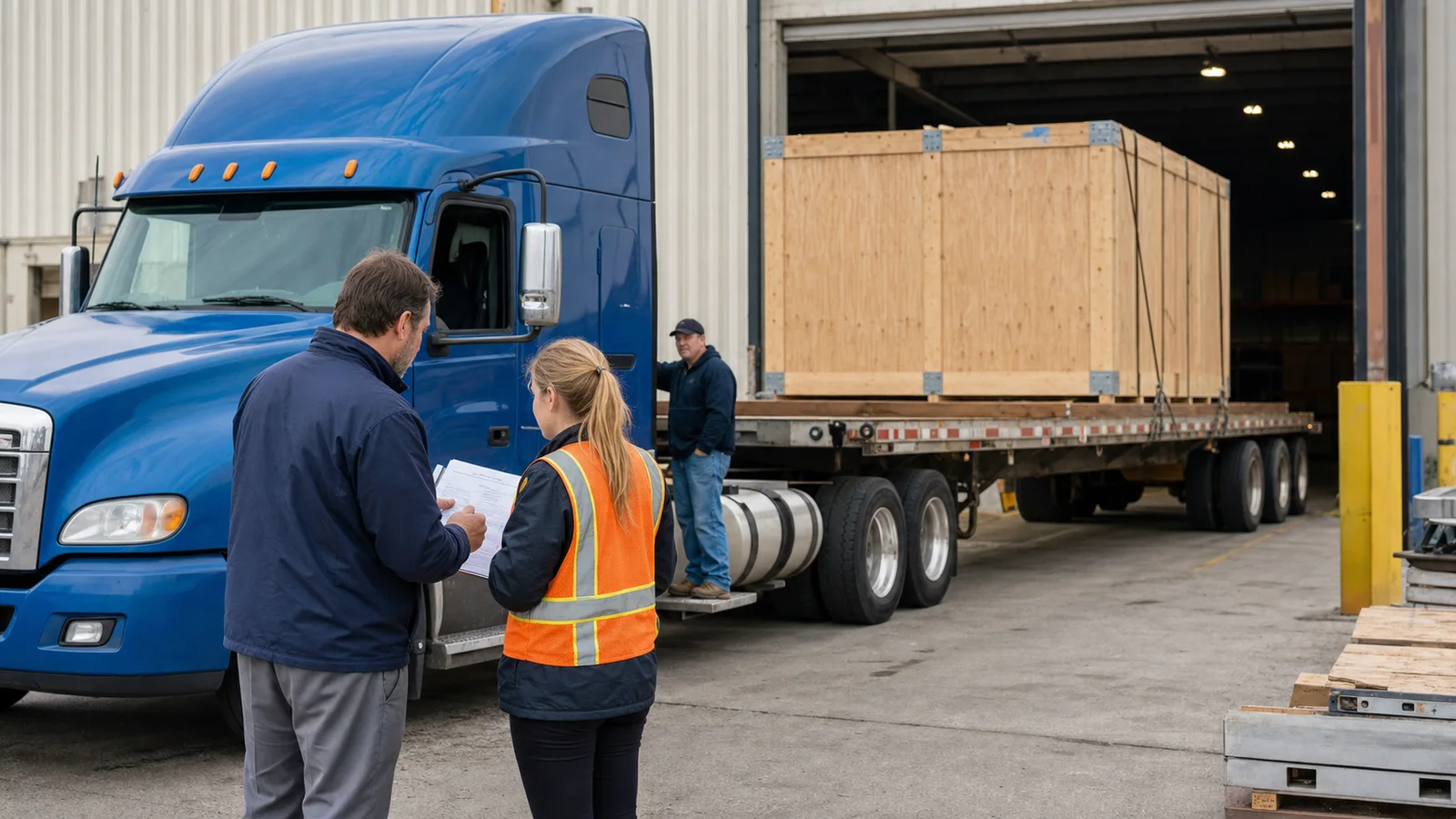
A containerized machine is devanned near Los Angeles and needs a flatbed move to Arizona. The international forwarder introduces a freight broker, but the buyer has not verified the broker or the selected motor carrier.
- The buyer verifies active FMCSA broker authority and financial-security filing, then confirms that the broker acts only as arranger for this load.
- The buyer issues machine weight, dimensions, center of gravity, securement drawing, pickup equipment, delivery crane window and carrier insurance criteria.
- The broker names the selected authorized carrier and issues a rate confirmation that includes permits, detention assumptions and no-rebrokering instructions.
- At pickup, the warehouse verifies carrier and vehicle identity, photographs securement and records milestones; the receiver notes package condition before crane unloading.
The broker arranges a verified carrier while the buyer retains control of load facts, equipment criteria and claim evidence.
Failure controls before cargo release
Use this table as a stop-release check. A responsible owner should resolve each trigger against the same cargo and document version before the shipment moves to the next handoff.
| Failure trigger | Operational consequence | Required control |
|---|---|---|
| Freight broker is assumed to be the carrier | Operating and liability roles are misassigned | Identify broker capacity and the actual motor carrier |
| Authority is checked only during onboarding | A suspended or changed status may be missed | Verify official status near tender under a risk policy |
| The load brief omits dimensions or site limits | The selected vehicle may be unsuitable | Issue one complete cargo, equipment and appointment version |
| A last-minute carrier change is not verified | Fraud or unauthorized re-brokering exposure increases | Use verified contacts and approve the named carrier before pickup |
| Claims are sent only to customer service | Contractual notice deadlines can be missed | Direct evidence and notices to every required legal recipient |
Quote-ready data handoff
Send the inputs together and label estimates. This gives the forwarder, carrier, broker and consignee one controlled starting version instead of a price request assembled from conflicting messages.
- Pickup and delivery legal names, addresses and appointments
- Commodity, package type, count, dimensions and gross weight
- Equipment, load distribution and securement requirements
- Loading, unloading, dock, crane or forklift responsibilities
- Dangerous-goods, temperature, security or food-grade status
- Declared value and requested insurance or carrier criteria
- Required broker and carrier authority checks
- Expected tracking, seal and identity-verification process
- Accessorial assumptions, payment and change approval
- Exception recovery, claim contacts and notice deadlines
Primary sources and verification boundary
These sources support the document, customs or dangerous-goods distinctions used in this guide. They do not replace a product-specific ruling, licensed customs advice or carrier acceptance for the actual shipment.
- U.S. Federal Motor Carrier Safety Administration – Carrier, broker and forwarder authority definitions: Under U.S. motor-carrier rules, a broker arranges transportation without transporting or assuming cargo responsibility, while a regulated freight forwarder consolidates and assumes responsibility for transportation.
- U.S. Federal Motor Carrier Safety Administration – Broker registration: A U.S. property broker needs FMCSA broker authority, a BMC-84 surety bond or BMC-85 trust at the required amount, a process agent filing and the applicable registration process.
- U.S. Federal Motor Carrier Safety Administration – 2026 broker and forwarder financial responsibility rule: From 16 January 2026, updated liquidity, suspension and trustee rules apply to the $75,000 financial security maintained by regulated U.S. property brokers and freight forwarders.
- U.S. Federal Maritime Commission – Ocean Transportation Intermediaries: In U.S. ocean trades, an ocean freight forwarder arranges exports for shippers, while an NVOCC operates as a common carrier without operating the vessels and has distinct licensing or registration obligations.
Related Sendwin resources and next actions
Use the links below to move from the reference answer into a live shipment decision. Each anchor identifies the destination topic so the relationship remains useful to buyers and search systems.
Compare adjacent logistics roles in the freight glossary.
Distinguish international coordination through the freight forwarder guide.
Map brokered final-mile costs with the shipping cost control guide.
Reconcile load and transport records in the shipping documents hub.
Define the full China-to-door handoff using the shipping process guide.
Send final-mile requirements in a shipment quotation request.
Frequently asked questions
The short answers below preserve the responsibility boundary. Confirm the actual cargo, date, lane, importer and accepting provider before relying on a general answer for release.
Does a freight broker transport the freight?
Under the FMCSA motor-freight definition, the broker arranges transportation and does not operate the vehicle or assume cargo responsibility. The named motor carrier physically transports the load.
How do I verify a freight broker?
Use official FMCSA records to check the legal entity, current broker authority and financial-security filing, then verify contacts and the selected carrier near tender.
Is the $75,000 broker bond cargo insurance?
No. The BMC-84 or BMC-85 supports broker financial responsibility for covered obligations. It is not a substitute for motor-carrier cargo coverage or shipment-specific insurance analysis.
Is a freight broker the same as a freight forwarder?
No. FMCSA distinguishes a broker that arranges motor transportation from a regulated freight forwarder that consolidates and assumes transportation responsibility. International forwarding also has broader, contract-specific meanings.
Ready to test the plan against final cargo data? Request a shipment-specific freight quotation.