

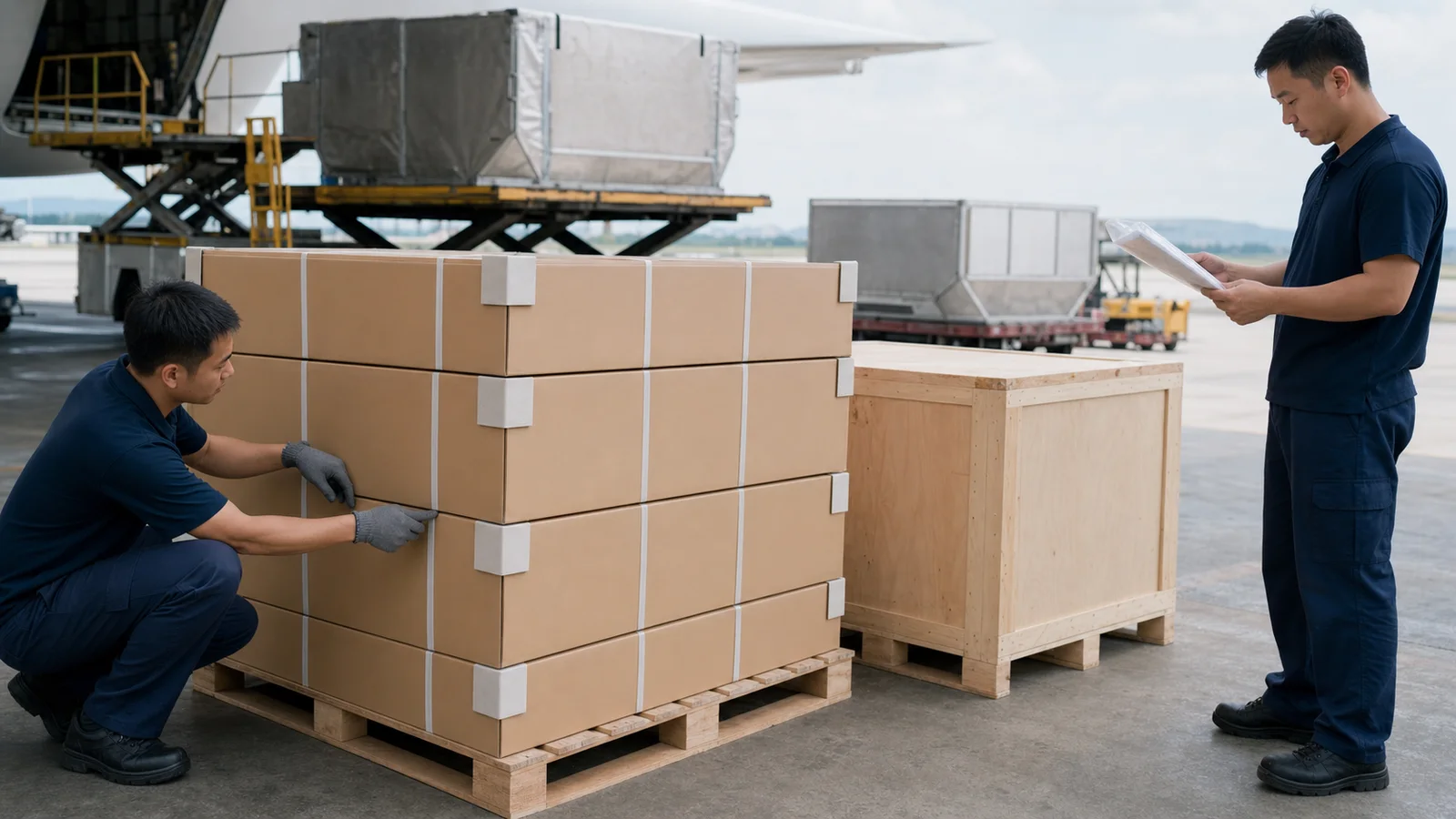
Prepare air freight from China to UK only after the importer has confirmed its EORI and VAT position, broker or declaration route, commodity information, and post-arrival delivery plan. The factory should finish export packing, provide package-level dimensions and weights, disclose batteries or other sensitive contents, and issue consistent invoice and packing records. Book space after those facts are approved, then recheck current UK and carrier rules before dispatch.
Decision framework for air freight from china to uk
Use the table as a pre-booking filter. It does not choose a carrier or customs treatment by itself; each row identifies the physical facts, responsible party and written evidence that must agree for this shipment.
| Situation | Best fit | Avoid when | Verify before booking |
|---|---|---|---|
| Importer and broker have approved the product and commercial documents | Proceed to compare airport or door-delivery air scopes | The quote is being used as evidence that the goods may enter Great Britain | Current EORI, importer role, commodity code decision, value, declaration route, and records |
| Cartons are finished and package data are stable | Request booking-quality pricing from final measurements | Palletizing, protection, or consolidation is still changing the cargo | Piece count, dimensions, gross weight, stackability, and priced chargeable weight |
| Cargo includes lithium batteries or another acceptance-sensitive feature | Obtain current airline and route acceptance before space is booked | The supplier supplies only a generic MSDS or an old approval | Exact configuration, rating, packing, available documents, route, and current acceptance |
| Consignee can clear and collect from a named UK airport | Consider airport-to-airport service with explicit handoff instructions | No collector, vehicle, or post-release process is confirmed | Arrival contact, broker, handling release, collection party, vehicle, and onward address |
| Final address has appointments, limited access, or unloading constraints | Request a door-delivery scope that states the final-mile conditions | The quote assumes a standard commercial delivery without checking the site | Postcode, address type, receiving hours, access, vehicle limits, and unloading owner |
Establish the UK import path before the factory releases cargo
The first readiness question is not which flight to use; it is whether the named importer can support the UK entry. Confirm the current EORI position, who will make or instruct the customs declaration, how duty and VAT will be handled, and which records the importer must retain. The importer or its broker should decide the commodity code and check product-specific requirements using current official guidance. A freight forwarder can coordinate movement and present supplied documents, but transport acceptance does not approve the product for the UK market or settle the importer’s legal obligations.
Send the broker a draft commercial invoice and packing list while the cargo is still at origin. The description should identify the product, material or function, model where useful, quantity, value, currency, origin, and the parties to the transaction. Packing totals must match the finished packages. Correct mismatches before pickup, not in an arrival queue. UK requirements and administrative processes can change, so recheck the current official steps before dispatch. For Northern Ireland or any transaction with a different regulatory path, obtain specific professional guidance instead of extending a Great Britain checklist by assumption.
- Current importer and EORI confirmation
- Broker or declaration instructions approved before pickup
- Product-specific and record-keeping requirements rechecked
Finish packaging before calculating chargeable weight
Air pricing depends on the finished transport packages. Record carton or pallet count, length, width, height, gross weight, and whether pieces may be stacked. Flag a long side, fragile crate, dense item, or pallet requiring a forklift. Ask the provider to state the chargeable weight used and the applicable method. Carton count alone cannot support a comparison because dimensional volume may outweigh physical mass under the quoted service. Do not reuse a parcel calculation as an airline-cargo result without checking the provider’s units, divisor, rounding, and minimum handling basis.
Packaging must survive origin handling, air-cargo build-up, destination handling, and final delivery. Use internal restraint and suitable outer strength rather than relying on stretch wrap to hold a weak carton together. If wood pallets, crates, or dunnage are used, confirm current destination treatment and marking requirements before fabrication and dispatch. A hypothetical machine part measured before crating may produce a materially different cargo profile once the protective base and frame are added. Re-measure after every approved packing change and update the booking before the cargo is collected.
- Final dimensions and weight after all protection
- Handling, stacking, and lifting restrictions
- Current wood-packaging checks where applicable
Complete the commodity and carrier-acceptance file
Give the forwarder an exact product description and disclose batteries, liquids, powders, magnets, aerosols, dry ice, chemicals, or temperature limits. For battery-powered goods, specify whether batteries are installed, packed with equipment, or shipped separately, plus chemistry, rating, quantity, and available test or safety documents. One broad category can contain several different acceptance outcomes. Do not change a description to make the cargo appear easier to carry; the physical configuration and packing must match the information reviewed by the airline or service provider.
Treat acceptance as route- and date-specific. An airline may request different evidence or decline a configuration that another service can carry, and requirements may change after a prior shipment. Ask what approval has been obtained, for which commodity configuration, route, packing, and ready date. If the supplier changes a battery, formulation, carton, or accessory bundle, stop and resubmit the file. The importer must separately verify product authorization and customs requirements. Airline acceptance, customs release, and permission to sell or use the goods are distinct decisions made by different parties.
- Exact physical configuration rather than a product-family label
- Current evidence requested for the selected route
- Separate transport, customs, and market-access decisions
Design the UK handoff after airport arrival
Specify whether the service ends at the arrival airport or continues to the final postcode. For airport service, name the arrival-notice contact, customs broker, party responsible for destination charges and release, collector, vehicle, and onward address. Do not describe that chain only as consignee pickup. The collector needs the correct release evidence and equipment after the cargo becomes available. A buyer far from the gateway should compare local cartage and coordination with a door-delivery offer, because the main air component does not reveal the complete destination workload.
For door delivery, provide the exact postcode, address type, receiving hours, appointment process, road or vehicle limits, dock, liftgate, forklift, and unloading responsibility. A standard commercial premise and a restricted city-centre site may need different vehicles and planning. Ask where carrier responsibility ends: curb, loading bay, inside receiving, or another defined point. Do not promise the receiver a delivery date based only on the flight plan. Customs release, cargo availability, local scheduling, and the site’s receiving rules all sit between aircraft arrival and completed delivery.
- Airport release and collection roles
- Final postcode and site constraints
- Clear endpoint for unloading and completed delivery
Use a written release gate for the UK booking
Before approving space, compare offers on the same origin pickup, export handling, route, priced weight, destination handling, customs scope, duty and VAT responsibility, local delivery, insurance, and validity date. Mark every item included, excluded, optional, or payable by another party. Ask what changes if the factory misses the cutoff or the final weight differs. An airport-to-airport total and a door-delivered total answer different questions; convert both into one responsibility table before deciding which is commercially better for the shipment.
Release cargo only when the final package record, commodity acceptance, commercial documents, importer and broker instructions, destination handoff, and exception contacts agree. Keep the approved version so any later supplier change is visible. Recheck current UK import guidance, carrier rules, and product requirements immediately before dispatch where they can change. If a required approval is still pending, record the shipment as not ready rather than treating a booked flight as the deadline that overrides compliance, packaging, or document evidence. That pause is cheaper than resolving an avoidable mismatch after arrival.
- Same cargo snapshot and service endpoint across quotes
- Importer and broker approval attached to the release
- Current-rule verification completed before dispatch
Inputs to send before requesting a quote
A useful quote begins with final cargo facts and named handoffs. Send the following information together so the response can separate assumptions from confirmed scope instead of hiding gaps inside one total price.
- Supplier pickup address, contact, and confirmed cargo-ready date
- Specific product description, material or function, model, and quantity
- Final package count, dimensions, gross weight, and stackability
- Crate, pallet, wood, lifting, fragile, or non-stackable details
- Battery, liquid, powder, magnet, aerosol, dry ice, or temperature disclosure
- Available current test, safety, and carrier-requested documents
- Commercial invoice value, currency, origin, and transaction details
- UK importer, EORI status, declaration route, and broker contact
- Preferred arrival airport or acceptable alternatives
- Final postcode, address type, receiving hours, and unloading needs
- Required delivery outcome and acceptable contingency
- Airport or door endpoint, requested inclusions, and quote validity
Failure modes to control before dispatch
| Trigger | Consequence | Control |
|---|---|---|
| Space is booked before the UK importer confirms its entry process | Cargo moves while EORI, declaration, value, or product questions remain unresolved | Have the importer and broker approve the current import path and documents before pickup |
| Chargeable weight is calculated before palletizing or crating | The final freight profile no longer matches the quote or equipment plan | Measure finished packages and re-confirm the booking after every packing change |
| A past battery approval is applied to a changed product or route | The airline can reject the cargo or require different packing and documents | Obtain current acceptance for the exact configuration, route, and dispatch date |
| Airport pickup has no named collector or suitable vehicle | Released cargo remains at the handling facility while parties arrange collection | Confirm release evidence, collector authority, vehicle, equipment, and onward address |
| Final delivery is quoted without postcode and site constraints | The planned vehicle or delivery method cannot complete the handoff as expected | Provide access, appointment, dock, liftgate, forklift, and unloading details before pricing |
Official sources and current-rule checks
The sources below support the regulatory or carrier-facing distinctions in this guide. Requirements can change by date, product, route and importer, so recheck the current primary source and the accepting carrier before dispatch.
- GOV.UK – Import goods into the UK step by step: EORI, commodity code, value, declarations, duty, VAT and record preparation for Great Britain.
- UPS Supply Chain Solutions – Chargeable and volumetric weight: Mode-specific chargeable-weight concepts for air, express and LCL freight.
- International Air Transport Association – Batteries: Current battery classification, packing, documentation and air-transport guidance.
- International Plant Protection Convention – ISPM 15: Wood packaging and dunnage phytosanitary requirements for international trade.
Related Sendwin shipping resources
Use the China-to-UK air freight planning page to define the route, chargeable-weight inputs, and service endpoint. See China-to-UK air freight planning.
Request a UK air-freight quote after the importer, final packages, commodity evidence, and destination handoff are ready. See request a UK air-freight quote.
Use China warehouse consolidation when several suppliers need receiving checks, repacking, and final package measurements. See China warehouse consolidation.
Compare international express alternatives for smaller accepted consignments that need an integrated final delivery. See international express alternatives.
Consider ocean freight from China when the order is stable enough for a slower mode or a split-shipment plan. See ocean freight from China.
Frequently Asked Questions
Does every UK importer need an EORI number?
Requirements depend on the import path and the party making the declaration. The importer should check current GOV.UK guidance and confirm the correct EORI and declaration setup with its broker before dispatch.
Can a forwarder choose the UK commodity code for the buyer?
The importer remains responsible for the entry and should confirm classification with appropriate guidance or a qualified adviser. The forwarder can transmit the approved information and flag inconsistencies in the shipping records.
Should dimensions be taken before or after palletizing?
Use the package configuration that will actually be tendered to the carrier. If palletizing or crating occurs later, treat the first quote as provisional and re-measure before booking approval.
Is airport pickup always cheaper than UK door delivery?
No. Airport pickup transfers brokerage coordination, release, collection, and onward transport to the consignee. Compare those tasks and their exposure with a written door-delivery scope rather than judging the main air charge alone.