

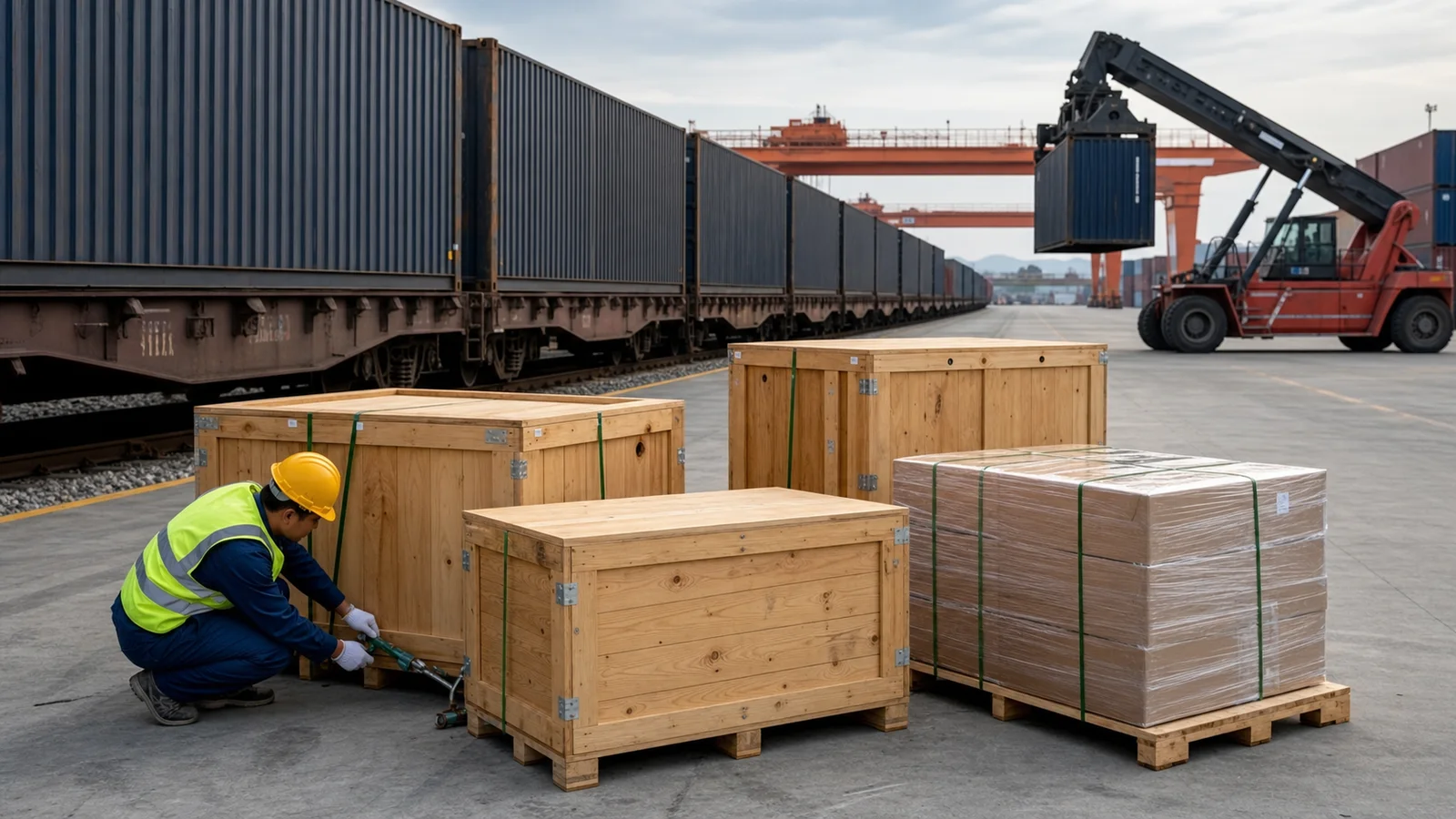
China Europe rail freight fits cargo that is too time-sensitive for the available ocean plan but does not need air, especially when the destination is inland and the shipment can tolerate terminal transfers. The decision depends on value density, packaging strength, terminal geometry, operator acceptance, and schedule tolerance. Rail is a poor fit when a narrow deadline cannot absorb variability, the cargo lacks transfer-ready packing, or the final truck leg erases the route advantage.
Decision framework for china europe rail freight
Use the table as a pre-booking filter. It does not choose a carrier or customs treatment by itself; each row identifies the physical facts, responsible party and written evidence that must agree for this shipment.
| Situation | Best fit | Avoid when | Verify before booking |
|---|---|---|---|
| Planned, mid-value cargo is bound for an inland European city with a usable rail terminal connection | Request a rail door-scope comparison with ocean | The final truck leg is long, restricted, or not included in the quoted route | Origin terminal, destination terminal, transfer points, final-mile scope, schedule, and current operator acceptance |
| Inventory has more urgency than the available ocean plan but no air-critical deadline | Use rail if the business can accept a schedule range and transfer buffer | The required date depends on one unbuffered departure or immediate border release | Cargo cutoff, departure frequency, schedule assumptions, border handoffs, and exception route |
| Dense, compact cargo has enough value to justify faster inventory recovery | Compare rail with ocean using total landed scope and inventory exposure | Bulky low-margin packaging makes the complete rail route commercially weak | Final CBM, piece weight, value, usable loading plan, terminal charges, and delivery cost |
| Fragile machinery, electronics, or mixed cartons can be packed for multiple transfers | Rail after a route-specific packing and handling review | The crate, pallet, moisture protection, or carton records assume a single uninterrupted move | Lifting points, restraint, stacking, moisture control, package IDs, and condition evidence |
| Cargo is oversized, acceptance-sensitive, temperature-sensitive, or documentation is incomplete | Keep rail provisional and compare another mode | A supplier dispatch would occur before operator and importer approval | Exact dimensions, special contents, route limits, customs data, importer readiness, and current rules |
Start with delivery geography, not the idea that rail is a middle mode
Rail earns a place in the comparison when the actual origin-to-destination geometry supports it. Identify the China collection point, departure terminal, European arrival terminal, customs handoff, and final truck destination. An inland consignee near a practical terminal pair may avoid part of the port-to-inland leg that weakens an ocean plan. A buyer near a seaport, however, may gain little after rail terminal handling and final trucking are included. Ask for the complete route and endpoint in writing rather than assuming the words China-Europe rail describe one standard service.
Do not select rail by placing it automatically between air and ocean on a speed chart. The useful question is whether the route’s cutoffs, transfers, border processes, and final-mile plan fit the buyer’s delivery window better than the current alternatives. Schedules vary by terminal pair, operator, ready date, and cargo, and they can change. Request a current routing note and a range of milestones, then preserve a buffer for customs and delivery. If one missed departure destroys the commercial value, the shipment may be air-critical rather than rail-suitable.
- Name the origin and destination terminals before comparing modes.
- Include pre-carriage and final trucking in the route geometry.
- Confirm current schedule and operator acceptance close to dispatch.
Screen the cargo for transfer-ready packaging and identification
Rail cargo can pass through terminals, equipment changes, and road legs, so the package must remain stable through repeated lifting and vibration. Provide final external dimensions, gross weight, center of gravity for heavy pieces, lifting or forklift points, stacking limits, and any prohibited orientation. Cartons need enough strength for the actual load pattern, while crates and pallets need structural restraint rather than decorative outer boards. Photograph internal restraint, closed packages, and the loaded condition so handoff records can distinguish pre-existing damage from a later exception.
Mixed-SKU cargo also needs durable identity. Map package IDs to the packing list, invoice, model, quantity, and destination allocation without relying on labels that may be covered or separated. If wood packaging or dunnage is used, confirm the current phytosanitary requirements for the destinations and transit plan before fabrication. Moisture-sensitive or temperature-sensitive goods require a route-specific exposure review; a faster main leg does not prove that every terminal dwell or truck handoff meets the product’s limits. Separate unsuitable items instead of forcing one service across the complete order.
- Disclose non-stackable, fragile, long, dense, and acceptance-sensitive pieces.
- Use package IDs that survive consolidation and terminal handoffs.
- Recheck packaging if the supplier changes the skid, crate, or carton.
Use value density and inventory timing without inventing a universal saving
Value density helps explain whether a faster inventory cycle has business value. Compact components, machinery parts, or finished goods with a costly stockout may support a rail premium over ocean, while bulky low-margin cargo may not. Calculate the decision internally from landed margin, replacement lead time, stockout exposure, and working capital; do not publish or rely on a universal percentage saving. The same shipment can change modes when the inventory position changes, even if its physical dimensions remain identical. That is a commercial decision, not evidence that one mode is always cheaper.
A hypothetical buyer could compare three matched scopes for the same final cargo: ocean to the actual inland door, rail to the same door, and air for only a critical subset. The useful output is not a winner by label but the condition under which each option protects value. If rail meets the inventory date with defensible buffer, air may add speed the business cannot monetize. If rail misses the date after a plausible transfer delay, the buyer can isolate urgent SKUs rather than upgrading every carton. Keep each movement’s invoice, packing, value, and receiving records separate.
- Use final packed CBM and weight in every comparison.
- Define the cost of a stockout or production stop internally.
- Compare current full-route quotes rather than remembered mode ratios.
Build the rail document and responsibility chain before pickup
Provide a specific commodity description, model or use, package count, dimensions, gross weight, declared value, shipper, consignee, and terminal route. Rail consignment data and the CIM-SMGS framework can support the transport-document chain, but the forwarder still needs accurate commercial records from the parties. The invoice and packing list should match the actual packages and any split shipment. Avoid descriptions such as parts or merchandise that do not identify the goods. A document accepted for transport does not by itself prove destination product compliance or importer eligibility.
The European importer should verify current tariffs, formalities, product requirements, commodity treatment, and customs responsibilities for the product and origin before dispatch. Incoterms can allocate delivery tasks, costs, and risk between seller and buyer, but the freight scope must still name pre-carriage, terminal handling, main rail, customs coordination, final trucking, duty and tax responsibility, unloading, storage, and exceptions. Rules and operating procedures can change, so recheck official sources, the selected operator, and the customs adviser close to pickup instead of reusing a previous route file unchanged.
- Align shipper, consignee, package, cargo, and route data across records.
- State who supplies customs instructions at each required handoff.
- Keep transport acceptance separate from market-access confirmation.
Use a rail booking gate that tests the weak link in the route
Before release, ask which single condition would make rail fail for this shipment. It may be a late supplier, unsuitable crate, uncertain terminal pair, missing importer instruction, restricted cargo, or final delivery constraint. Assign an owner and evidence to that condition. The booking file should also show final measurements, current acceptance, cargo cutoff, schedule assumptions, route endpoint, rate validity, insurance decision, handoff contacts, and the action to take if the planned departure is missed. This converts a broad mode preference into an auditable shipment decision.
Rail should remain provisional whenever the forwarder has not seen the final cargo facts or confirmed the actual route. If the supplier changes quantity, packaging, special contents, ready date, or destination, refresh acceptance and the comparison with ocean and air. Do not release cargo because rail worked for a previous order or because it is described as faster than sea. Approve it only when the complete route, package, documents, importer, and schedule tolerance align, and verify current operating and regulatory requirements immediately before dispatch.
- Record the fallback if a cutoff or terminal connection is missed.
- Confirm final-mile access and unloading before the European terminal release.
- Stop dispatch when acceptance or documentation remains conditional.
Inputs to send before requesting a quote
A useful quote begins with final cargo facts and named handoffs. Send the following information together so the response can separate assumptions from confirmed scope instead of hiding gaps inside one total price.
- Specific commodity, model, intended use, and customs-description details
- China pickup city, supplier contact, and confirmed cargo-ready date
- Proposed origin rail terminal and European destination terminal
- Exact final delivery address and receiving constraints
- Final package count, dimensions, gross weight, and total CBM
- Longest side, individual heavy pieces, center of gravity, and lifting points
- Stackability, fragility, moisture, temperature, and vibration limits
- Declared value, required delivery date, and schedule tolerance
- Importer, broker, and EU product-requirement readiness
- Wood packaging and any batteries, liquids, or acceptance-sensitive contents
- Requested comparison with ocean, air, and a possible split shipment
Failure modes to control before dispatch
| Trigger | Consequence | Control |
|---|---|---|
| The quote names rail but omits the actual terminal pair and final truck leg | The buyer cannot judge route fit, delivery time, or complete cost | Require the full origin-terminal-destination chain and exact service endpoint in writing |
| Packaging is designed for one direct move rather than repeated transfers | Vibration, lifting, stacking, or moisture causes avoidable damage | Approve transfer-ready restraint, package strength, handling points, and condition photos |
| A narrow deadline relies on one departure with no exception buffer | A missed cutoff or transfer removes the commercial value of the route | Use a milestone range, define schedule tolerance, and document a fallback mode |
| The importer or product requirements are reviewed after pickup | Cargo reaches a border or terminal before the entry path is ready | Verify current destination formalities, product requirements, and customs ownership before dispatch |
| Rail is selected from an assumed cost or speed ratio | Pre-carriage, transfers, final delivery, or inventory economics reverse the decision | Compare matched current door scopes using final cargo and business-specific timing inputs |
Official sources and current-rule checks
The sources below support the regulatory or carrier-facing distinctions in this guide. Requirements can change by date, product, route and importer, so recheck the current primary source and the accepting carrier before dispatch.
- UNECE – CIM-SMGS rail consignment note: Rail consignment data and the CIM-SMGS documentation framework.
- European Commission – Access2Markets: EU tariffs, procedures, formalities and product requirements by product and origin.
- International Plant Protection Convention – ISPM 15: Wood packaging and dunnage phytosanitary requirements for international trade.
- International Chamber of Commerce – Incoterms rules: Incoterms allocate delivery tasks, costs and risks; they do not replace a written freight scope.
Related Sendwin shipping resources
Use the ocean freight hub as the matched baseline when deciding whether rail protects enough time or handling value. See ocean freight benchmark for European cargo.
Submit final cargo, terminal, destination, and deadline data through the quote page for a current route review. See request a route-specific rail comparison.
The rail service page is the relevant route resource once terminal geometry and operator acceptance are part of the decision. See China-Europe rail freight service.
Review air freight when the required date cannot absorb rail schedule variability or only a critical subset needs speed. See air freight for truly deadline-critical cargo.
Warehouse consolidation is relevant when packages, suppliers, and records must be stabilized before terminal dispatch. See warehouse preparation for rail-ready cargo.
Frequently Asked Questions
Which cargo usually deserves a China-Europe rail comparison?
Consider rail for accepted cargo with more urgency than the available ocean plan, enough value to benefit from earlier inventory, and practical inland terminal geometry. Final packing must also tolerate the route’s transfers and truck legs.
Is rail freight always faster than ocean and cheaper than air?
No universal relationship applies to every terminal pair, ready date, cargo, or destination. Compare current full-route scopes and preserve buffer for transfers, customs, and final delivery.
What packaging details matter most for rail cargo?
Provide final dimensions and weight, structural restraint, stacking limits, lifting points, moisture controls, and durable package IDs. Heavy or fragile pieces also need center-of-gravity and condition evidence where relevant.
When should a rail booking be reverified?
Reverify after any change to cargo, packing, ready date, terminal pair, destination, or special contents and again before dispatch. Operator acceptance, schedules, customs procedures, and product requirements can change.