

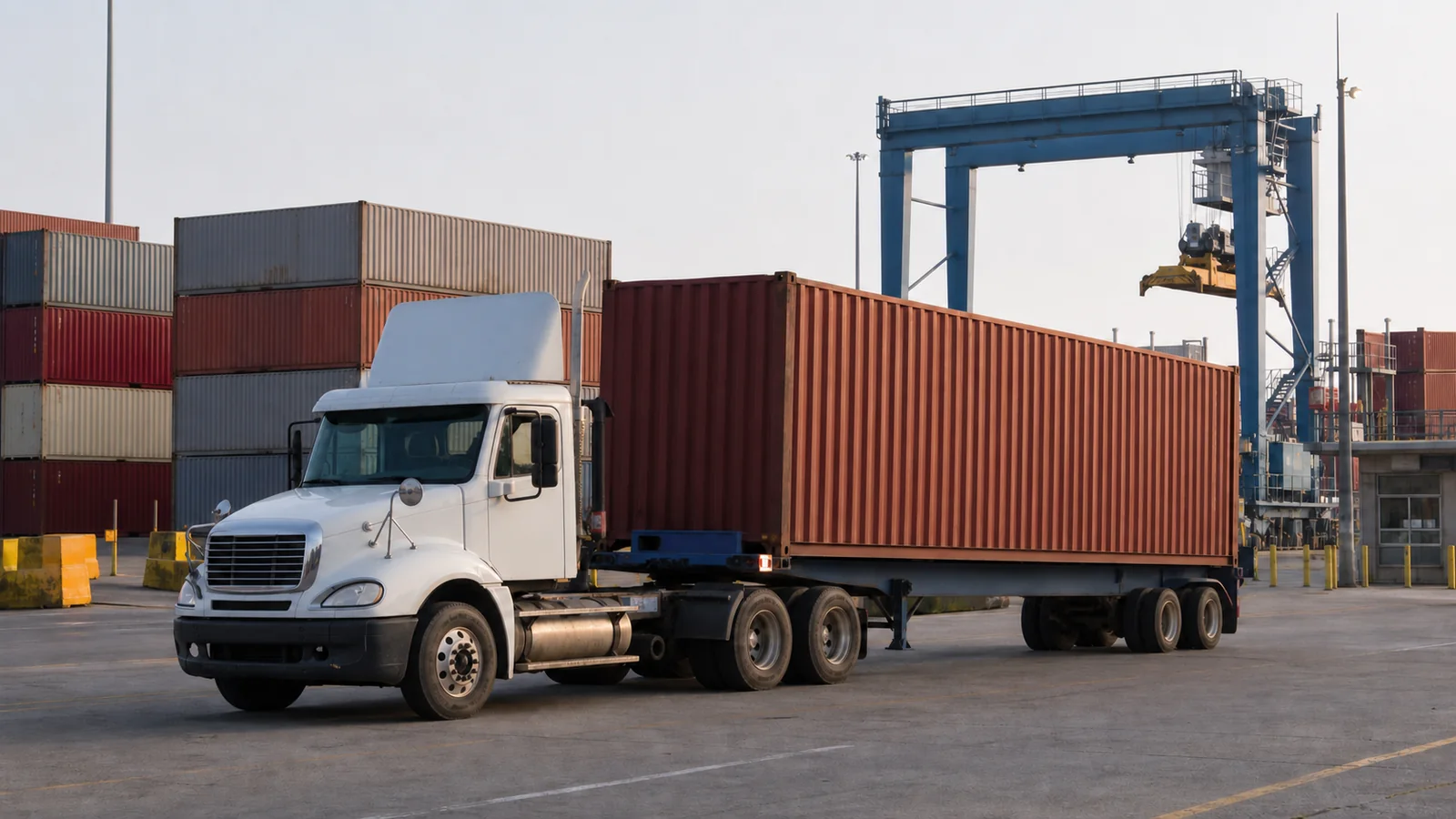
Every freight quote has a finish line, and most China quotes stop at the port
The invoice that catches importers off guard is usually not a scam. It is a map problem. A quote from a Chinese forwarder is priced to a geographic point, and when that point is the port of discharge, everything that happens after the crane sets your container on the ground sits outside the number you approved. Nobody hid it. The forwarder quoted what they were asked to quote, in the format the origin-side market quotes in.
Then the box lands. A US customs broker files the entry and sends a bill. A trucking company pulls the container and sends another one. The terminal charges for the days it sat. The warehouse charges to unload it. None of those companies were part of your email thread, and none of their charges were on the quote.
So the question worth asking before you book is not whether a quote is cheap. It is where the quote stops, and what lives on the other side of that line. Here is the map, drawn from the factory floor to your receiving door, with the boundary marked.
A cost map from the factory floor to your receiving door
| Where the cost happens | Typical charges | Inside a port-to-port China quote? | Who normally invoices you |
|---|---|---|---|
| China, factory to vessel | Pickup trucking, export declaration, origin terminal handling, document and B/L fee, VGM, security or ISPS, telex release, CFS charges on LCL | Depends entirely on the Incoterm. Under FOB the supplier usually absorbs most of it; under EXW none of it | Chinese forwarder, or buried in the supplier’s unit price |
| Ocean leg | Base ocean freight plus carrier surcharges: bunker or fuel, low-sulfur, peak season, general rate increases, war risk or routing surcharges when in force | Yes. This is the line everyone shops | Chinese forwarder |
| US terminal, on arrival | Destination terminal handling (DTHC or DDC), wharfage where it applies, port-specific programs, container release and chassis fees, CFS deconsolidation on LCL | Rarely | US agent, CFS operator, or the trucker who fronted it |
| US customs | Entry filing, customs bond, duties and any additional tariff programs, merchandise and harbor user fees, partner-agency filings (FDA, USDA, EPA, FCC), exam and hold costs | Almost never, unless the quote is explicitly DDP | Customs broker, who also passes through what CBP collects |
| US inland, port to your door | Drayage and fuel, pre-pull, chassis per day, terminal storage past free time, per diem or detention, appointment and waiting time, liftgate or residential delivery, unloading and lumper fees | No | Drayage carrier and receiving warehouse |
The row that decides how much of this is yours is the first one. The trade term you agreed with your supplier sets the handover point, and everything downstream of that point is on your account whether or not anyone quoted it. If you have not read the Incoterms rules on who pays for what against your own purchase order, do that before you argue about a freight invoice, because most of these disputes are settled by the term, not by the email.
The charges that live behind the line
The terminal side
Destination terminal handling is the mirror image of the origin charge: the cost of moving your container across the yard at the discharge end. Whether it is prepaid or collect depends on how the booking was made, and a quote that says “freight prepaid to Long Beach” very often still leaves DTHC for you to pay locally.
Chassis are the line that surprises first-time FCL importers. Ocean carriers in the US largely stepped back from supplying chassis, so the trailer under your container typically comes from a pool and is billed by the day, from the day it is pulled to the day it is returned. If the chassis has to be collected from a different location than the container, that is billed again as a split. Some gateways also run local fee programs on top; the traffic mitigation fee at Los Angeles and Long Beach is the best known, and you should check whether your discharge port has an equivalent rather than assume it does not.
On LCL, the destination side is where the “LCL is cheap” idea usually falls apart. Deconsolidation at the container freight station, handling per cubic meter or per revenue ton, and document release fees are all charged at destination, and they are charged on the same chargeable-weight basis you were billed on at origin. A small LCL consignment can carry more cost after the port than across the ocean.
Customs, duty and the government-side fees
Your broker charges to file the entry and to arrange a bond. You are choosing between a single transaction bond for one shipment and a continuous bond that covers a year of entries, and the answer depends on how many entries you file and how much duty is at stake. Ask your broker to price both rather than defaulting to whichever they mention first.
Duty itself runs off your HTS classification, plus whatever additional programs apply to that classification and origin. Rates, program scope and exclusion lists change, sometimes with very little notice, so the only safe method is to take your own classification and look it up against the current tariff schedule published by the USITC and the current guidance from CBP, then confirm it with your broker in writing. Do not take a duty rate from a supplier, and do not take one from an article. The same applies to the merchandise processing and harbor maintenance fees: both are calculated as a percentage of value with statutory floors and caps that are adjusted periodically, so pull the current figures from CBP when you build your model. Our walkthrough of how to calculate landed cost from China sets out the arithmetic with the places to look up each input.
Then there are the costs that only appear when your container is selected for inspection. An X-ray scan is the cheap outcome. A tailgate exam costs more. A full intensive exam means the container is moved to a government-approved examination site, stripped, inspected and repacked, and you pay for the site, the extra drayage, the additional chassis days and any storage that accumulates while it happens. The importer of record pays even when the exam finds nothing wrong. Budget for the possibility, and read the customs clearance process so you know who is doing what while your box sits.
Getting the container out and to your door
Drayage is priced by distance band from the port plus fuel, and that price assumes one clean trip: the container is available, the appointment holds, the driver arrives, unloads and returns the empty. Every deviation has its own code. A pre-pull, where the box is taken out of the terminal early and staged at the trucker’s yard to avoid storage, buys you time and costs chassis days. A dry run, where the driver arrives and the container is not available, is billed, as is waiting beyond the free minutes at your door.
The clock charges deserve their own attention. Demurrage runs while the container sits inside the terminal past its free time. Per diem or detention runs once the box is outside the terminal and still in your possession. The free days come from the carrier’s tariff or from your service contract, not from anyone’s goodwill, so get the number of free days in writing at booking rather than discovering it on an invoice. US rules on how these bills must be issued, itemized and disputed have been tightened in recent years, and the requirements have kept moving, so if you receive a demurrage or detention invoice you cannot reconcile, check the Federal Maritime Commission’s current billing requirements before you pay it.
Delivery accessorials are the last group. Liftgate, residential or limited-access delivery, appointment scheduling, inside delivery and unloading all carry charges, and warehouses commonly charge to devan by carton or by pallet. A live unload keeps the driver waiting on your clock; a drop-and-pick avoids that but adds chassis days. Neither is wrong, but only one of them was in the assumption behind your quote.
Who invoices you, and when
Cash timing catches people almost as often as the amounts do. The origin-side and ocean charges are settled around sailing, often before the bill of lading is released. Duty and the broker’s entry charges come due at or immediately before entry, and if the broker fronted the duty they will want it back quickly. Terminal storage and per diem invoices arrive after the fact, sometimes weeks after the container was returned. Trucking accessorials frequently arrive on a second invoice after the first one has already been paid.
The practical effect is that three or four invoices from three or four companies land within a couple of weeks of arrival, and the first container is where that hits hardest. Our breakdown of China shipping costs is worth reading alongside this one if you are building a landed cost model for the first time.
Why the ocean line is the easiest one to discount
There is a structural reason the port-to-port number is the one that comes back low. It is the only line buyers can compare across quotes, because it is the only line every forwarder presents in the same shape. The destination side has no reference price in the buyer’s head, so a quote that stops at the port has fewer places to be undercut.
This is not automatically a trick. A Chinese forwarder quoting to the port genuinely has no control over your US drayage or your broker unless they hold an agent relationship at destination. But it does mean the number you compared carried less information than you assumed. The fix is to move the finish line before you compare, not after the invoices arrive.
Move the finish line before you compare
Send the same message to everyone you are asking. The wording matters less than the fact that every quote comes back drawn to the same endpoint.
- State the endpoint yourself: quote to my delivery ZIP code, delivered to the door, not to the port.
- Say explicitly whether duties and tariffs are inside or outside the number, and ask for it both ways if you are comparing DAP against DDP.
- Ask for the destination items itemized even if some are estimates, and ask which are fixed and which are estimates.
- Ask how many free days you get at the terminal and on the container, and from which event the clock starts.
- Ask which lines are passed through at cost and which carry a margin.
- Ask who the US broker and the drayage carrier will be, and whether you can be invoiced by them directly.
- Ask what happens if the container is selected for exam: who arranges it, who pays, and how you will be told.
| Item behind the line | The question to ask | What a clear answer contains |
|---|---|---|
| Destination terminal handling | Is DTHC prepaid in your quote or collect at destination? | A stated amount or a stated per-container rate, and the party who will bill it |
| Chassis and drayage | Does the drayage rate include chassis, fuel and one appointment? | A rate, plus the named extras with their own rates: pre-pull, split, dry run, waiting time |
| Entry and bond | What does the entry cost, and are you quoting a single or continuous bond? | Both bond options priced, with the entry volume at which the continuous one pays for itself |
| Duty and user fees | Which HTS code are you filing under, and which additional programs apply? | The code in writing, so you can verify it against the current tariff schedule yourself |
| Free time | How many free days at the terminal, how many on the container, from what event? | Two separate day counts and the trigger event, confirmed at booking rather than after arrival |
| Exam exposure | If it goes to an intensive exam, what will I be billed for? | The site fee, the additional moves, the chassis days and the storage, named as separate lines |
| Delivery | Is it a live unload or a drop, and what is included at my door? | Free unloading minutes, liftgate and residential rates if relevant, waiting time rate |
Before you approve anything
A quote that stops at the port is not a bad quote. It is an incomplete one, and it becomes dangerous only when it is compared against a quote that does not stop there. Redraw both to the same endpoint, put the destination items on the page even as estimates, and the cheap quote and the expensive quote often swap places.
If you want a second opinion drawn to that endpoint, send your shipment details, the trade term you agreed with your supplier and your delivery ZIP code, and ask for the quote to be built door to door with the destination lines itemized. That is the same request you should be making of everyone you are asking, including whoever quoted you first. You can send it through our freight quote request, and if you are still deciding between a full container and a shared one, the FCL and LCL ocean freight page sets out how the destination charges differ between the two.