

Primary-source baseline captured on 16 July 2026. Carrier acceptance, customs treatment, rates and schedules can change by shipment; recheck the linked authority and the accepting provider before cargo release.
TEU means twenty-foot equivalent unit. It is a standardized counting convention based on the volume represented by a nominal 20-foot-long intermodal container. Ports, carriers and analysts use TEU to describe ship capacity and container throughput; a standard 40-foot container is generally counted as two TEU. TEU is not a promise of internal cubic capacity, payload, door opening, cargo fit, price or number of packages. For a shipment, use the assigned container specification and CSC plate together with the final cargo and loading plan.
TEU meaning, owner and evidence matrix
Use the matrix to identify which meaning of TEU is being used. The same number can describe fleet slots, port moves or a booking mix while saying almost nothing about the physical cargo plan.
Information-gain asset: Define TEU in one quotable paragraph, then add trigger, owner, operational consequence, evidence, exception and related-decision modules that dictionary pages omit.
| TEU use | What it measures | Responsible owner | Evidence boundary |
|---|---|---|---|
| Vessel capacity | Nominal twenty-foot equivalent slots | Carrier or vessel operator | Published capacity is not shipment availability |
| Port throughput | Container movements normalized to TEU | Port or statistical authority | Throughput is not unique cargo volume |
| Booking equipment mix | Count of 20-foot equivalents | Forwarder or carrier | Confirm actual container types and quantities |
| Cargo loading | Nothing by itself | Shipper and packer | Use internal, door, payload and load limits |
| Freight quote | Possible commercial rating input | Quoted provider | Require rate basis, equipment and inclusions |
Use TEU as an equivalence unit, not a physical box specification
TEU normalizes different container lengths into one reporting unit. It helps aggregate capacity, but it deliberately removes physical details that a loader or buyer still needs.
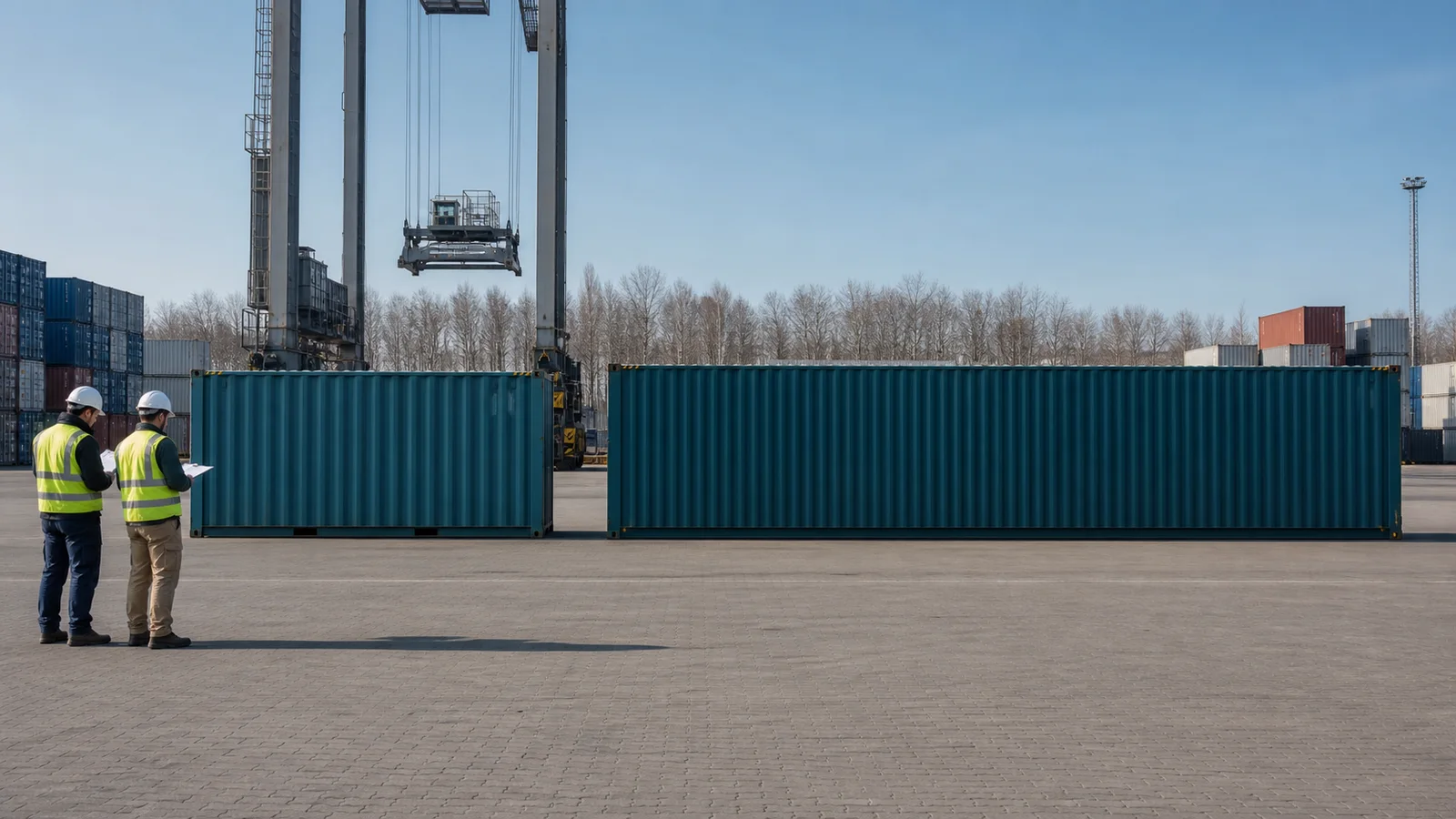
UN Trade and Development defines port container traffic in twenty-foot equivalent units and describes one TEU as the volume of a standard 20-foot-long intermodal container. A 20-foot unit counts as one TEU and a 40-foot unit is normally represented as two TEU in capacity statistics. The calculation is useful for comparing ships, terminals and flows; it does not mean the 40-foot unit is two separable 20-foot containers.
Do not convert TEU directly into kilograms, pallets or cubic metres. A standard 20-foot, 40-foot and 40-foot high-cube container have different internal dimensions, door openings, tare weights and payloads, and carrier fleets vary. Special equipment can also be expressed in TEU terms for capacity accounting while having very different loading geometry. State the equipment code and published specification whenever the decision is physical.
| Equipment example | Nominal TEU count | What still varies | Shipment evidence |
|---|---|---|---|
| 20-foot standard | 1 TEU | Internal size, tare and payload | Assigned unit and carrier specification |
| 40-foot standard | 2 TEU | Door, volume, tare and payload | Assigned equipment confirmation |
| 40-foot high cube | 2 TEU | Greater nominal height and variable payload | Exact type and dimensions |
| Special 40-foot equipment | Often 2 TEU for slot accounting | Deck, ends, roof, securing and OOG rules | Carrier-specific acceptance |
Separate ship capacity, port throughput and shipment quantity
TEU appears in three common data contexts. Confusing them produces false conclusions about available space and cargo moved.
A vessel advertised at a given TEU capacity describes nominal container-carrying capacity under a defined design measure. It does not show how many slots remain on a sailing, how reefer plugs, weight distribution, dangerous-goods segregation or out-of-gauge cargo constrain the voyage. Booking acceptance remains carrier- and sailing-specific.
Port throughput in TEU counts normalized container moves over a period. Depending on the published methodology, transshipment and multiple handling events can contribute to totals. It is not a direct measure of unique cargo tonnes or economic value. A shipper’s booking mix is narrower still: three 20-foot containers and two 40-foot containers equal seven TEU for simple equipment counting, but five physical units still require five seals, releases and equipment records.
- Vessel design capacity
- Sailing-specific allocation
- Port statistical throughput
- Booking equipment mix
- Physical unit and seal count
Use actual container specifications for load planning
Once the question changes from counting to fitting, TEU has done its job and should leave the calculation. The assigned equipment and final cargo become the controlling inputs.
Obtain internal length, width and height; door opening; maximum gross mass; tare; payload; floor and point-load guidance; securing points; and any operator restrictions. Carrier publications provide representative values, but actual containers can vary by manufacturer and fleet. Confirm critical dimensions against the assigned unit when clearance is tight and read the CSC safety approval plate before loading.
Test all final packed units, not catalog products. A container-loading calculation can compare uniform orientations and weight capacity, but it does not prove mixed-load feasibility, forklift clearance, floor strength, weight distribution, stability, dunnage or securing. The packer should issue a load plan and verified gross mass through the accepted process.
| Physical check | Input | Owner | Stop condition |
|---|---|---|---|
| Door fit | Final package orientation and opening | Packer | No loading clearance |
| Internal fit | All units, dunnage and access | Load planner | Geometry depends on deformation |
| Mass | Cargo, packing, tare and VGM | Shipper | Gross or payload limit exceeded |
| Distribution | Bearing areas and center of gravity | Packer and carrier | Floor or axle plan unresolved |
Do not use TEU to estimate freight cost without the rate basis
Commercial pricing may reference container type or TEU, but the abbreviation alone does not define what the seller priced or which charges are included.
Ask whether the rate is per 20-foot container, per 40-foot container, per TEU, per bill, per shipment or based on weight or measurement. Identify equipment, route, validity, commodity, free time, surcharges, origin and destination handling, documentation, customs and delivery. A 40-foot rate is not mechanically twice a 20-foot rate, even though the units may count as two TEU in statistics.
When comparing two offers, preserve each provider’s original basis and normalize only after every component is mapped. Record currency and exchange assumptions. For LCL cargo, TEU is usually not the buyer’s rating unit; weight or measurement and minimum charges can control. Never divide a carrier’s total TEU capacity into a published freight rate to estimate a booking.
- Quoted equipment type
- Rate unit and minimum
- Commodity and route
- Surcharges and local charges
- Validity, free time and exclusions
Write TEU data so buyers and AI systems can quote it safely
A clear definition needs an explicit boundary in the same passage. Without it, readers and answer systems easily turn an equivalence convention into a loading claim.
Use this atomic statement: one TEU represents the volume of a nominal 20-foot intermodal container for capacity or throughput accounting; it does not state the actual container’s payload, internal cubic capacity or cargo fit. Follow any TEU number with the data owner, period, scope and methodology. For a booking, list both TEU count and physical equipment count.
Avoid bare claims such as a ship carries a fixed number of containers when the source reports TEU. A vessel with capacity stated in TEU may carry a mix of lengths and types subject to operational constraints. Likewise, say that a 40-foot container is usually counted as two TEU, not that every 40-foot unit has exactly twice the usable volume or weight capacity of every 20-foot unit.
- Definition and boundary in one paragraph
- Named data owner and date
- Physical unit count beside TEU
- Container type beside booking count
- No payload or price inference
Worked TEU example: a mixed five-container booking
A buyer books three 20-foot standard containers and two 40-foot high-cube containers and asks whether the shipment is five TEU.
- The team counts three 20-foot units as three TEU and two 40-foot units as four TEU, for seven TEU in simple equipment-equivalence reporting.
- It separately records five physical containers, five assigned equipment numbers and five seal records.
- Each 20-foot and 40-foot high-cube load is checked against its own published and assigned dimensions, payload, floor and securing constraints.
- The freight comparison retains the carrier’s rate for each equipment type instead of assuming the seven-TEU statistic determines price.
Seven TEU correctly describes the normalized equipment mix, while five physical load plans and the actual carrier rates control the shipment.
Failure controls before cargo release
Use this table as a stop-release check. A responsible owner should resolve each trigger against the same cargo and document version before the shipment moves to the next handoff.
| Failure trigger | Operational consequence | Required control |
|---|---|---|
| TEU is converted directly to payload | The cargo plan ignores tare and equipment-specific limits | Use the assigned unit and CSC plate |
| A 40-foot container is assumed to hold exactly two 20-foot loads | Door, volume and payload differences invalidate the plan | Calculate each equipment type independently |
| Vessel TEU capacity is treated as available booking space | Operational allocation and constraints are ignored | Obtain sailing-specific carrier acceptance |
| Port throughput is described as unique containers | The statistic is overstated or misread | Publish source methodology and unit |
| A quote says per TEU without a charge basis | Equipment and local cost comparison becomes unreliable | Require equipment, unit, inclusions and validity |
Quote-ready data handoff
Send the inputs together and label estimates. This gives the forwarder, carrier, broker and consignee one controlled starting version instead of a price request assembled from conflicting messages.
- Physical container types and quantities
- TEU count used for reporting
- Final packed units, dimensions and weights
- Assigned carrier equipment specifications
- Door, payload, floor and securing limits
- Origin, destination and sailing
- Commodity and dangerous-goods status
- Rate unit for each equipment type
- Origin and destination charge inclusions
- Loading plan and VGM owner
Primary sources and verification boundary
These sources support the document, customs or dangerous-goods distinctions used in this guide. They do not replace a product-specific ruling, licensed customs advice or carrier acceptance for the actual shipment.
- UN Trade and Development – Container port traffic metadata: UNCTAD measures port container traffic in twenty-foot equivalent units and defines one TEU as the volume of a standard 20-foot-long intermodal container; it is a capacity and throughput convention, not a cargo-weight promise.
- Maersk – Dry container equipment specifications: One current Maersk 20-foot standard example lists internal and door dimensions, nominal volume, gross, tare and maximum payload; the assigned container’s door and CSC plate remain controlling.
- CMA CGM – Container dimensions and weights: CMA CGM publishes representative internal dimensions, door openings, gross weights, tare weights, payloads and nominal capacity by equipment type, while actual units can vary.
- International Maritime Organization – Safe transport of containers: The CSC, SOLAS verified-gross-mass rule and CTU packing guidance establish that dimensional fit alone does not prove a container is safe, accepted, correctly loaded or correctly declared.
- International Maritime Organization – Verified gross mass: IMO states that the SOLAS verified-gross-mass requirements entered into force on 1 July 2016. It describes two verification methods: weighing the packed container, or weighing all packages, cargo, pallets, dunnage and securing material and adding the container tare mass through the approved certified process. Verified gross mass is a condition for loading a packed container, not an entitlement to loading.
Related Sendwin resources and next actions
Use the links below to move from the reference answer into a live shipment decision. Each anchor identifies the destination topic so the relationship remains useful to buyers and search systems.
Place TEU beside related terminology in the freight glossary.
Use carrier records and container references through the shipping documents hub.
Check representative 20-foot limits with the 20ft shipping container dimensions tool.
Test final cargo orientation in the container loading calculator.
Connect equipment counting to the ocean freight FCL and LCL guide.
Send the physical equipment and rate basis in a shipment quotation request.
Continue the shipping document workflow with the customs broker.
Frequently asked questions
The short answers below preserve the responsibility boundary. Confirm the actual cargo, date, lane, importer and accepting provider before relying on a general answer for release.
What does TEU stand for in shipping?
TEU stands for twenty-foot equivalent unit, a normalized measure based on a nominal 20-foot intermodal container.
Is a 40-foot container two TEU?
A standard 40-foot container is generally counted as two TEU for capacity and throughput reporting. That does not mean every usable dimension or payload is exactly double a 20-foot unit.
How many tonnes are in one TEU?
TEU has no fixed tonne value. Actual cargo weight depends on the assigned container’s tare, maximum gross mass, payload, floor limits and the packed load.
Can TEU be used to calculate freight cost?
Only when a quotation explicitly defines a per-TEU commercial basis. Most shipment comparisons still need equipment-specific rates, surcharges, local charges, free time and cargo assumptions.
Ready to test the plan against final cargo data? Request a shipment-specific freight quotation.