

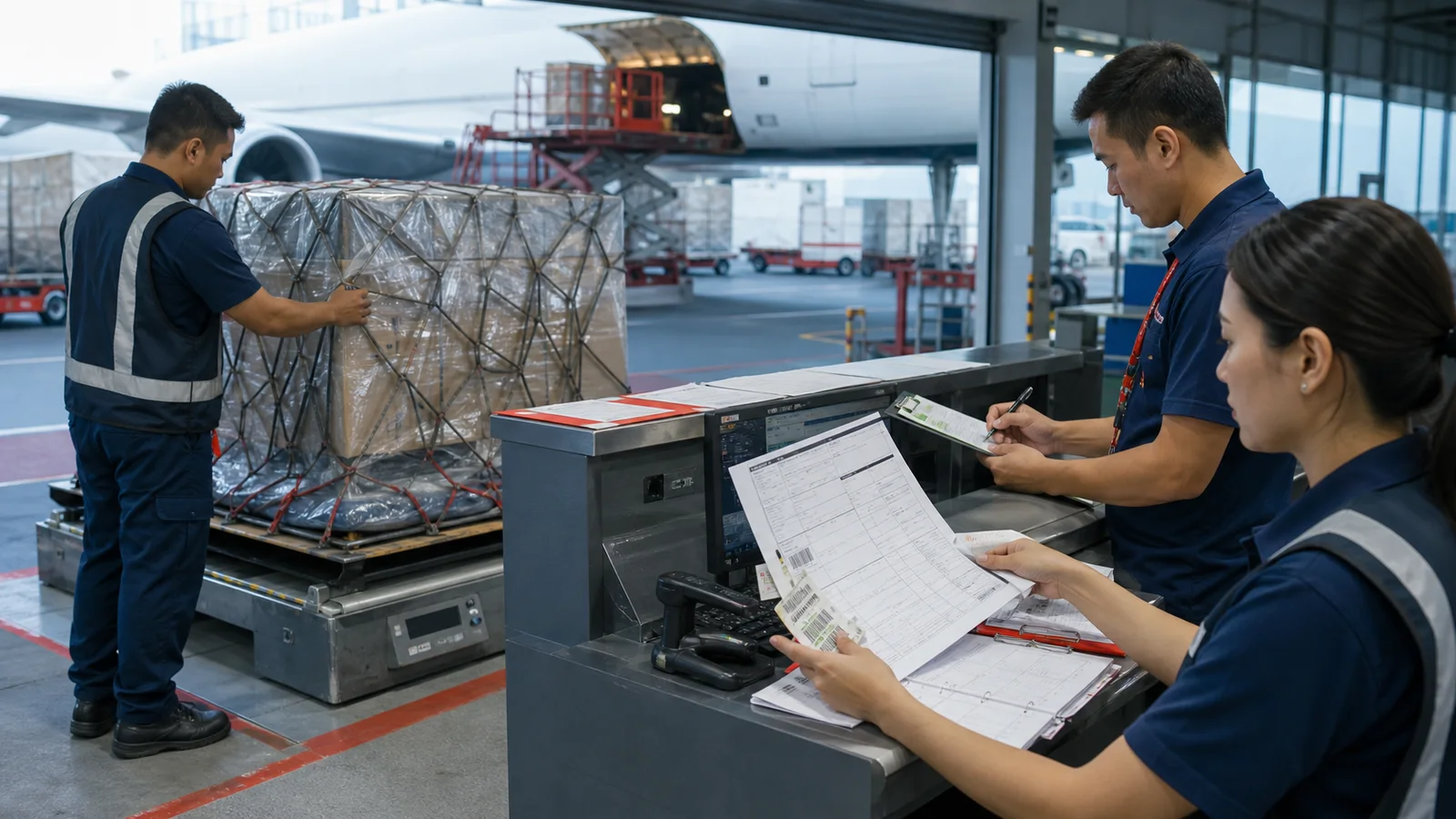
Primary-source baseline captured on 16 July 2026. Carrier acceptance, customs treatment, rates and schedules can change by shipment; recheck the linked authority and the accepting provider before cargo release.
An air waybill is the air-cargo contract of carriage between shipper and carrier and is normally non-negotiable. The airline or authorized agent issues the master air waybill, while a forwarder can issue a house air waybill for a consolidated shipment. The operational job is to reconcile parties, airport routing, pieces, weight, dimensions, commodity and charge instructions before acceptance, then keep the master, house, customs and delivery references connected.
Air waybill preparation and acceptance matrix
The AWB becomes useful only when the data reflects accepted cargo and the booked movement. Approve each control before the shipment crosses the carrier cutoff.
Information-gain asset: Show the lifecycle of air waybill: issuer, recipient, timing, mandatory fields, reconciliation checks, error recovery, and the evidence retained after release.
| Control point | Owner | Evidence | Reject or pause when |
|---|---|---|---|
| Party instruction | Shipper and consignee | Approved legal names, addresses and account roles | Old broker or incomplete consignee appears |
| Cargo data | Warehouse and shipper | Accepted pieces, gross weight, dimensions and description | Draft uses estimated packaging |
| Routing | Forwarder and carrier | Origin, destination, flight routing and service acceptance | Airport code or transfer differs from booking |
| Master-house map | Forwarder | MAWB, HAWB, pieces, weights and shipment references reconcile | House totals do not roll into master data |
| Electronic status | Carrier and authorized agent | e-AWB or paper process and final accepted message state | A sent message is mistaken for carrier acceptance |
Understand what the AWB does and does not do
The air waybill records the carriage contract and shipment instructions but is not a negotiable title document. Cargo release, customs and payment controls rely on named parties, carrier systems and destination procedures rather than transfer of an original AWB.
Use the accepted AWB number as one shipment reference, not the only record. Link it to booking confirmation, security and acceptance status, invoice, packing list, dangerous-goods records where applicable, customs filing, arrival notice and delivery order or release workflow.
An e-AWB process removes the paper requirement where the carrier and lane use the framework, but electronic does not mean uncontrolled. Identify who creates, transmits, accepts, corrects and archives each data message and which status proves carrier acceptance.
Review AWB fields against their source evidence
A spelling review is not enough. Every party, cargo and routing field should be compared with the record that owns the fact and with the physical shipment presented to the carrier.
| Field | Evidence source | Review question | Typical error |
|---|---|---|---|
| Shipper and consignee | Commercial and importer instruction | Are legal identity and contact details current? | Sales contact replaces consignee entity |
| Airport and routing | Accepted booking | Do airport codes and transfers match the booked service? | City and airport are treated as the same endpoint |
| Pieces and gross weight | Final warehouse and scale record | Does the accepted cargo equal the AWB totals? | Repacking changes pieces after draft |
| Commodity and handling | Product and acceptance file | Is the description specific and are special codes justified? | General cargo hides batteries or liquids |
| Charges and account | Quotation and payer instruction | Are prepaid, collect and account data approved? | Incoterm is copied into the wrong payment field |
| Declared values | Insurance and customs instruction | Are carriage, customs and insurance values distinguished? | One amount is reused without context |
Reconcile MAWB and HAWB data in consolidation
A master air waybill covers the airline movement, while house air waybills identify individual forwarder shipments. The parties can differ by layer, but pieces, weight and routing must form a traceable consolidation.
Build a table linking each HAWB to the MAWB, shipper, consignee, packages, gross weight, chargeable weight, description, invoice, customs reference and destination release record. The sum should explain the master movement without erasing shipment-specific controls.
When one house shipment changes, evaluate whether the master totals, manifest, security status, dangerous-goods declaration, flight booking or build plan also changes. Record a new accepted version rather than editing a local spreadsheet while the carrier system keeps the old data.
- MAWB number, airline prefix and accepted booking reference.
- HAWB number and commercial shipment owner.
- Piece, gross-weight and chargeable-weight reconciliation.
- Commodity and special-handling-code justification.
- Origin and destination agent mapping for each house shipment.
Control cargo description and special handling
Air-cargo acceptance is sensitive to what the shipment contains, how it is packed and which declarations or handling codes apply. A generic description can conceal a dangerous-goods, security, temperature, live-animal or valuable-cargo requirement.
Use a plain-language description supported by product data. Screen for batteries, power banks, liquids, powders, magnets, compressed gas, chemicals, dry ice, temperature controls and other acceptance-sensitive contents before booking. The correct dangerous-goods process must be determined by trained and authorized parties.
Do not add a special handling code merely because it seems helpful. The code should correspond to the accepted service and evidence. Make sure warehouse labels, documents, booking data and physical packing communicate the same handling condition.
Manage e-AWB transmission, correction and archive states
Electronic messages move faster than paper but can still be rejected, corrected or superseded. Define status names and evidence so the team knows whether data is drafted, transmitted, accepted by the carrier or accepted with an error requiring action.
| State | Evidence | Next owner | Control |
|---|---|---|---|
| Draft | Internal version identifier | Shipper reviewer | Compare with final cargo and booking |
| Transmitted | Message timestamp and reference | Carrier system or agent | Do not equate transmission with acceptance |
| Accepted | Carrier response or visible accepted status | Operations team | Lock the version used for handoff |
| Rejected or warning | Error code and affected field | Data owner | Correct the source fact and retransmit |
| Archived | Final AWB and response trail | Record owner | Keep linked shipment and amendment evidence |
Worked document example: three HAWBs under one MAWB
A forwarder consolidates three accepted shipments for one flight. One supplier changes from four cartons to two pallets after the first draft, increasing dimensions while gross weight stays similar.
- Replace the affected house package and dimension data from the final warehouse record.
- Recalculate chargeable weight and review whether the accepted rate and booking still apply.
- Update the consolidation roll-up and master pieces or weight where required.
- Rescreen handling and security status after the packing change.
- Transmit the corrected data and record the carrier’s accepted status before flight handoff.
The team can prove which physical cargo supports each HAWB and how the three records reconcile to the MAWB. The changed packaging is treated as a new operational fact, not a cosmetic document edit.
Failure controls before cargo release
Use this table as a stop-release check. A responsible owner should resolve each trigger against the same cargo and document version before the shipment moves to the next handoff.
| Failure trigger | Operational consequence | Required control |
|---|---|---|
| AWB draft precedes final weighing | Chargeable weight and accepted cargo differ | Approve pieces, dimensions and gross weight from the final handoff record |
| Battery or liquid content is described as general cargo | Carrier acceptance and safety controls can fail | Screen product evidence before booking and use trained dangerous-goods support |
| HAWB totals do not reconcile to MAWB | Manifest, customs and destination records lose traceability | Maintain a master-house roll-up with controlled versions |
| Electronic transmission is assumed accepted | Cargo reaches cutoff with unresolved data errors | Capture carrier response and assign rejection recovery |
| Airport code is copied from an old lane | Routing and destination handling are misdirected | Verify origin, destination and transfer against the accepted booking |
Quote-ready data handoff
Send the inputs together and label estimates. This gives the forwarder, carrier, broker and consignee one controlled starting version instead of a price request assembled from conflicting messages.
- Legal shipper, consignee and notification contacts.
- Final pieces, outside dimensions, gross weight and packing type.
- Specific commodity description and acceptance-sensitive contents.
- Origin airport, destination airport and requested door endpoints.
- Ready date, required arrival event and accepted flight routing.
- MAWB and HAWB structure for direct or consolidated cargo.
- Freight charge instruction, account and quotation reference.
- Customs, insurance and carriage value instructions where applicable.
- Special handling, dangerous-goods, temperature or security evidence.
- Electronic-message owner, correction channel and archive requirement.
Primary sources and verification boundary
These sources support the document, customs or dangerous-goods distinctions used in this guide. They do not replace a product-specific ruling, licensed customs advice or carrier acceptance for the actual shipment.
- International Air Transport Association – e-freight and e-AWB: The air waybill is the contract of carriage between shipper and airline, and the e-AWB framework removes the paper requirement where adopted.
- U.S. International Trade Administration – Common Export Documents: Official distinctions among commercial invoices, packing lists, air waybills and ocean bills of lading.
- U.S. Customs and Border Protection – Bill of Lading: Transport-document data including shipper, consignee, cargo, packaging and route.
- General Administration of Customs of China – Import and Export Declaration Documents: China export declarations may require the contract, invoice, packing list, manifest, transport document and applicable licences to reconcile.
Related Sendwin resources and next actions
Use the links below to move from the reference answer into a live shipment decision. Each anchor identifies the destination topic so the relationship remains useful to buyers and search systems.
Connect AWB fields with invoice, packing, customs and arrival records air cargo document control.
Send accepted cargo, route and handling facts for a scoped response air freight quote with final AWB data.
Review cargo acceptance, airport handoffs and chargeable weight air freight from China.
Compare parcel and commercial air-cargo document paths international express shipping from China.
Clarify carrier, forwarder, shipper and consignee roles MAWB and HAWB freight terms.
Check final dimensions against actual gross weight before AWB approval volumetric weight calculator.
Continue the shipping document workflow with the bill of lading.
Frequently asked questions
The short answers below preserve the responsibility boundary. Confirm the actual cargo, date, lane, importer and accepting provider before relying on a general answer for release.
Who issues an air waybill?
The airline or its authorized agent issues the master air waybill. A freight forwarder can issue a house air waybill for an individual shipment in a consolidation. The shipper supplies and approves accurate instructions.
Is an air waybill negotiable?
An air waybill is normally non-negotiable and is not an order bill of title. Cargo delivery follows carrier, customs and consignee procedures rather than transfer of an original AWB.
What is the difference between MAWB and HAWB?
The MAWB covers the airline movement between the carrier and its contracting party. A HAWB identifies a forwarder’s individual customer shipment. Their pieces, weights, routing and references must reconcile.
Does e-AWB mean no document checks are needed?
No. It changes the paper process, not the need for accurate data, authorization, acceptance status, correction controls and linked commercial, customs and handling evidence.
Ready to test the plan against final cargo data? Request a shipment-specific freight quotation.