

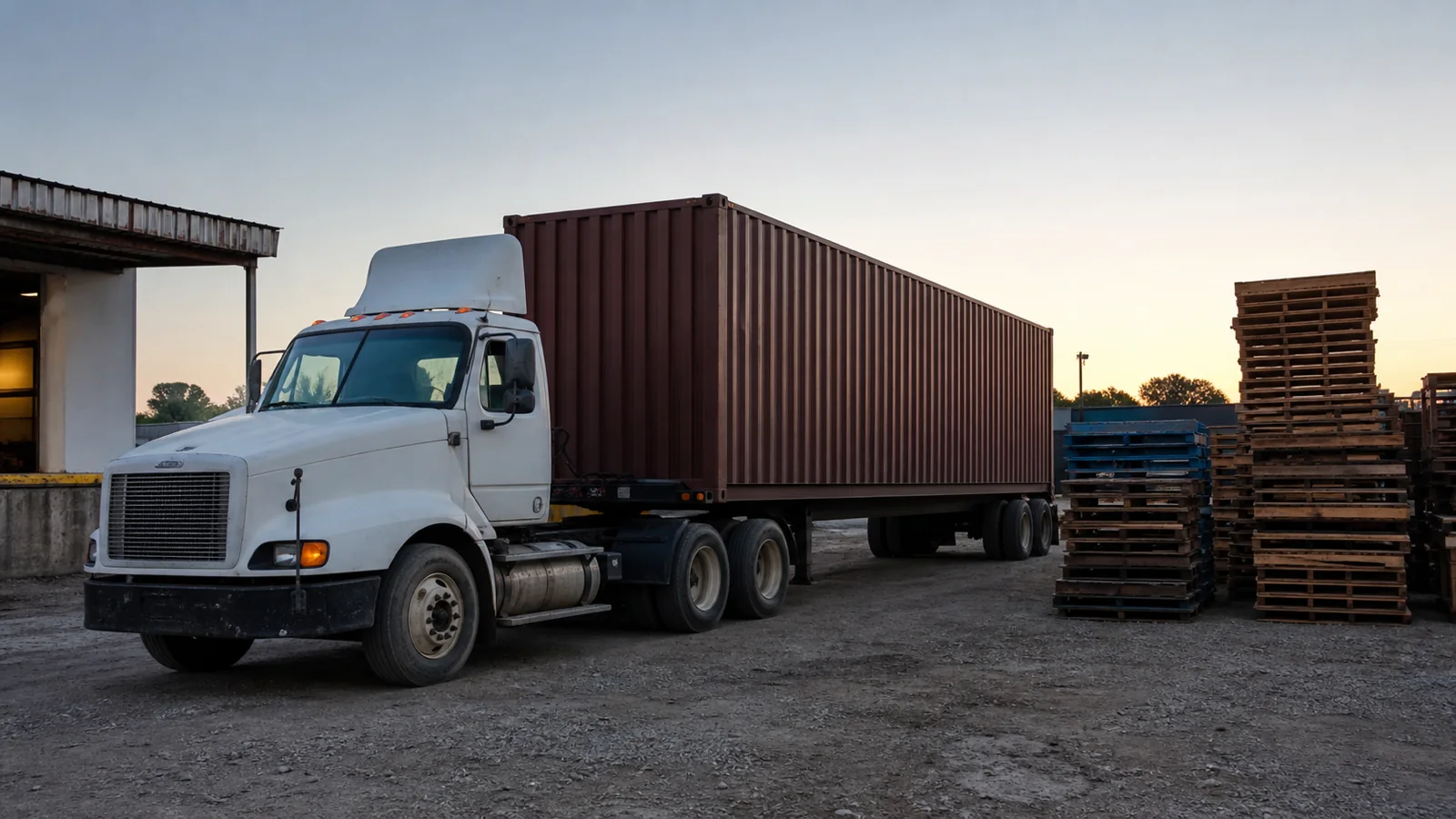
A container on the ground is not a container that has been received
The vessel discharges, tracking flips to something reassuring, and the seller starts counting down to the day inventory goes live. Then two weeks pass and the box is still sitting on a chassis in a yard somewhere inland, accruing charges from three companies, because nobody has an appointment to hand it over to Amazon.
This is the most expensive gap in the whole China-to-FBA chain, and it is not a transit problem. Everything upstream of it is under contract: the sailing, the customs entry, the trucker. The delivery appointment is the one step where a party you have no commercial relationship with decides your date, using capacity rules you cannot see. You can plan the rest of the move perfectly and still lose more money here than you saved on the ocean rate.
Who actually requests the ISA, and why it is not you
Deliveries into an Amazon fulfillment center are scheduled through Carrier Central, Amazon’s portal for the carriers that physically show up at the dock. An account there is built around a SCAC, the standard carrier alpha code issued to motor carriers. That one requirement decides everything else. The appointment request is submitted by the delivering trucker. Not by the seller, not by your forwarder’s China office, and not by Amazon.
In practice the requester is your drayage company, or the US agent who nominated them. Amazon returns an ISA, the inbound shipment appointment identifier, along with a delivery window. The driver quotes that number at the gate. No ISA, no gate.
The request itself needs the shipment identifiers from your inbound plan, carton count, pallet count, weight, the date the freight is genuinely ready, and whether the delivery is a live unload or a drop. Those figures have to match what rolls up to the dock. A request submitted against a carton count that changed after the plan was built is one of the quieter ways a load gets turned away.
The failure mode is almost always the same, and it is not technical. Under FOB terms the buyer assumes the US agent handles the booking. The US agent assumes the seller’s prep partner handles it. It was never named in anyone’s quote, so it gets discovered on the day the container needs to move. Put the question in writing before the booking is confirmed: who submits the Carrier Central request, against which shipment IDs, and on what day.
If a shipment is moving under one of Amazon’s own managed freight or partnered carrier programs, appointment handling sits somewhere else again. Confirm which regime a given shipment is in rather than assuming, because sellers routinely run a partnered domestic leg and a non-partnered ocean leg in the same quarter and then apply last quarter’s assumption to this one.
The lead-time question, answered honestly
Everyone wants a number for how far out appointments land. There isn’t a stable one, and anyone quoting you a fixed figure is describing their last shipment rather than yours. What moves it is the specific facility, its current inbound volume, the season, and how flexible you are willing to be on window and unload type. The useful move is not to find the number. It is to submit the request as early as the plan allows, and to check the offered window against your free time before you commit the drayage.
Live unload versus drop matters more than it looks, too. A live unload means the driver waits while the facility works the load, and that wait is billable time under most drayage contracts. A drop leaves the equipment behind and changes the cost profile completely, but it is often not available for an ocean container sitting on a pool chassis. Ask your trucker which one the appointment was requested as, because someone made that choice on your behalf.
Four things have to be true before the appointment is worth anything
An ISA in hand is not the same as a container you are allowed to move. Four releases have to line up, and any one of them still open on your appointment date burns the slot.
- Customs release. The entry has to be filed and released before the box leaves the terminal. If it is flagged for exam, your appointment date is now hypothetical. Worth understanding before it happens rather than during, which is what our customs clearance guide is for.
- Freight release from the carrier. Ocean freight settled, original bill of lading surrendered or telex release issued. Sellers on FOB terms sometimes learn on the last free day that the supplier never released the documents.
- Terminal availability and a terminal appointment. Most major US container terminals run their own appointment system for pickup, entirely separate from Amazon’s. You are queuing twice, in two systems that do not talk to each other.
- A trucker with capacity in that specific window. An Amazon window is a window, not a day. Drayage capacity at six in the morning on a Tuesday in peak season is a real constraint, not a formality.
Sequence these backwards from the ISA window instead of forwards from arrival and most of the surprises disappear.
While you wait, four meters are running
The slot you are offered may fall past your free time. This is where the money actually leaks, and most sellers find out weeks later, from invoices issued by companies they have never heard of.
| Charge | What it is billed against | Usually invoiced by | Stops when |
|---|---|---|---|
| Demurrage | Cargo sitting inside the marine terminal past free time | Ocean carrier, passing through terminal storage | The container is picked up and leaves the terminal gate |
| Detention, also called per diem | The carrier’s container being outside the terminal past free time | Ocean carrier | The empty is returned and gated in, not when you finish unloading |
| Chassis rental | The chassis under the box, counted by day | Chassis pool or your trucker | The chassis goes back |
| Yard or street storage | The loaded box parked somewhere waiting on the appointment | Trucker or yard operator | You move it |
| Warehouse storage | Pallets sitting in a facility after a transload | The warehouse | The inventory ships in to the FC |
Two details matter more than any rate card. Detention stops on the empty return gate-in, not at the moment you finish unloading, so a container stripped on Friday afternoon and returned on Monday costs you the weekend. And terminal storage and carrier free time are quoted separately and do not always start on the same day, which is why “we get several days free” is a meaningless sentence until you ask which clock is being described. If the vocabulary is unfamiliar, the freight glossary defines these terms.
Who pays is a contract question rather than a fairness question. These invoices generally follow the party named on the bill of lading and the party whose account the container moved out on, and most carrier bills of lading carry a merchant clause that makes shipper and consignee jointly liable. Amazon is not a party to any of it and will not absorb it. If a US demurrage or detention invoice reaches you and looks wrong, the Federal Maritime Commission has rules governing what such an invoice must contain, who may properly be billed, and how you dispute it. Read the current version on the FMC’s own site before you pay, since both the requirements and the timelines have been revised in recent years.
The lever that costs nothing is asking for more free time when the booking is made rather than when the bill arrives. It is negotiable more often than sellers assume, particularly on committed volume. Our shipping cost breakdown shows where these charges sit relative to the ocean rate you were comparing.
Why one container frequently cannot go to one fulfillment center
Amazon assigns destinations when the inbound plan is created, and a single plan can split across more than one facility. A forty-foot container that arrives as one unit against a plan naming two or three FCs cannot be delivered as one unit. Something has to break it apart. The only open question is where, and at what cost.
Palletization is the second constraint. Amazon publishes pallet, stacking, weight and labeling requirements in Seller Central and revises them. Rather than repeat figures here that will be stale by the time you read this, check the current requirements against your carton dimensions before the goods are packed, because the cheapest place to fix a pallet is a warehouse in China, not a yard in California. Building and labeling pallets to spec at origin is exactly what warehousing and consolidation exists to do.
Whether a given facility will accept a floor-loaded container at all is facility-specific. Do not assume it, and do not let a supplier floor-load a container on the theory that it saves pallet cost at origin without confirming the receiving end first.
Which brings up the comparison sellers rarely price out honestly.
| Factor | Container direct to the FC | Transload at a US warehouse first |
|---|---|---|
| Plan names one FC | Works well | Adds handling you may not need |
| Plan splits across FCs | Not possible as one delivery | The only clean route |
| Pallets built to spec at origin | Required | Can be corrected on arrival |
| Container clock | Runs until the appointment is served and the empty is back | Stops days earlier, empty returns after stripping |
| Appointment slips | Full exposure, the loaded box waits | Cargo is off the box, you wait on warehouse storage instead |
| Refused at the dock | Nowhere to put it | Fix it and re-present |
| Feeding inventory in over time | All of it goes in at once | Metered against sell-through |
| Cost shape | Lower when nothing goes wrong | Higher baseline, far less variance |
Direct delivery is genuinely the right answer for a single-FC plan, palletized to spec at origin, with the appointment requested well before the vessel berths and sensible free time on the booking. That describes a real and common set of shipments, and anyone telling you transloading is always better is selling warehouse space. It stops describing your shipment the moment a second facility appears on the plan.
Refused at the dock: the order the recovery has to happen in
Refusals come from a short and predictable list. No appointment or an expired one. Counts that do not match the request. Missing or unscannable unit and shipment labels. Pallets that overhang, exceed the stated height, or are stacked unsafely. A driver arriving outside the window. The wrong facility entirely.
The refusal itself is not the expensive part. The next few hours are.
- Get the reason in writing from the driver or dispatch before the truck leaves the area. Verbal reasons get relayed through three parties and arrive at your desk as “Amazon rejected it,” which is not something you can act on.
- Decide immediately where the equipment goes. Back to the terminal, to a yard, or to a warehouse. This decision, made under pressure in the first hours, sets most of the final cost.
- Fix the problem at a facility with a dock and labor. Never at the FC gate, and never on a trailer in a parking lot.
- Re-request the appointment as a fresh request. Treat a slot as hard to move rather than something you can nudge, and build that assumption into the timeline you promise your team.
- Confirm the inbound plan and its labels are still valid. If the plan went stale while you were rebuilding pallets, you may be relabeling rather than just restacking.
Sellers with no US address anywhere in their plan handle step two badly, and not because they are careless. Every option in front of them at that moment is expensive. Knowing the fallback address before you need it is most of the fix.
What to settle before the vessel sails
Nearly all of this is decided in China, weeks before anyone thinks about an appointment.
- Confirm in writing who submits the Carrier Central request, and against which shipment IDs.
- Build and label pallets to Amazon’s current requirements at origin, checked against Seller Central on the day of packing rather than from a checklist someone saved a year ago.
- Ask what free time is included on the booking, which clock it refers to, and whether more is available at the rate you are being quoted.
- Check how many facilities the plan names before you decide anything goes direct.
- Name the fallback destination now, while it is a line in a plan rather than a decision made from a truck cab.
If you want this comparison as a number instead of an argument, the input is small: the inbound plan with its FC assignments, carton dimensions and weights, pallet counts, and your ready date. Give that to whoever is quoting your ocean leg and ask for the direct-to-FC route and the transload route priced separately, with the free time on the booking stated in writing. Our Amazon FBA shipping page sets out the legs we handle out of China, and you can request a freight quote with the plan attached so the numbers come off your actual FC assignments rather than an average.